
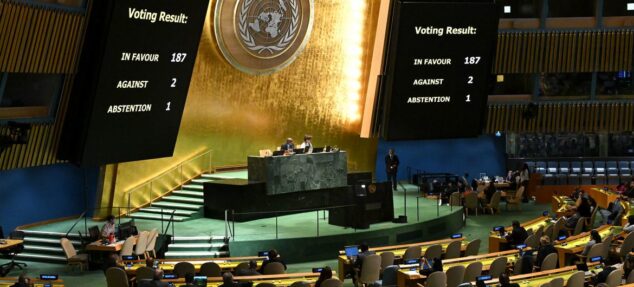
The UN General Assembly on Wednesday, for the 33rd consecutive year, adopted a resolution calling for an end to the decades-long United States embargo against Cuba.
An overwhelming majority of the UN’s 193 Member States once again urged Washington to lift the measures despite a noticeable shift in the number of countries choosing to either abstain or side with the US.
The resolution, titled Necessity of ending the economic, commercial and financial embargo imposed by the United States of America against Cuba, was adopted by 165 votes in favour, seven against, and twelve abstentions.
In 2024, the measure passed with 187 votes in favour, two against (the US and Israel), and one abstention (Moldova).
Those voting against this year’s resolution were the US, Israel, Argentina, Hungary, Paraguay, North Macedonia, and Ukraine.
The twelve abstentions came from Albania, Bosnia and Herzegovina, Costa Rica, Czechia, Ecuador, Estonia, Latvia, Lithuania, Morocco, Poland, Moldova, and Romania.
Explaining its decision to abstain, Poland also speaking on behalf of Czechia, Estonia, Latvia, and Lithuania – said its stance reflected “the selective application of the UN Charter”, citing Cuba’s continued support for Russia amid its full-scale invasion of Ukraine, where Cuban nationals have reportedly been fighting on Moscow’s side.
Romania echoed those concerns, noting that while it had long supported the resolution, “foreign involvement in an illegal war of aggression is a blatant violation of the UN Charter and international law”, and called on Cuba to withdraw its support for the invasion.
While the resolution remains non-binding, its passage once again signals the international community’s disapproval of unilateral coercive measures with extraterritorial effects.
Also Read: UN Members to Sign Global Cybercrime Treaty in Vietnam
The text reiterates the Assembly’s long-standing appeal for all States to reject punitive US legislation such as the Helms-Burton Act of 1996, which Cuba and other countries argue violates international law and the UN Charter.
The Assembly also highlighted measures adopted by former US President Barack Obama in 2015 and 2016 to modify some aspects of the embargo, “which contrast with the measures applied since 2017 [under the first Donald Trump administration] to reinforce its implementation.”
Through the resolution, the General Assembly also decided once again to include the embargo issue on the provisional agenda of next year’s session.
