
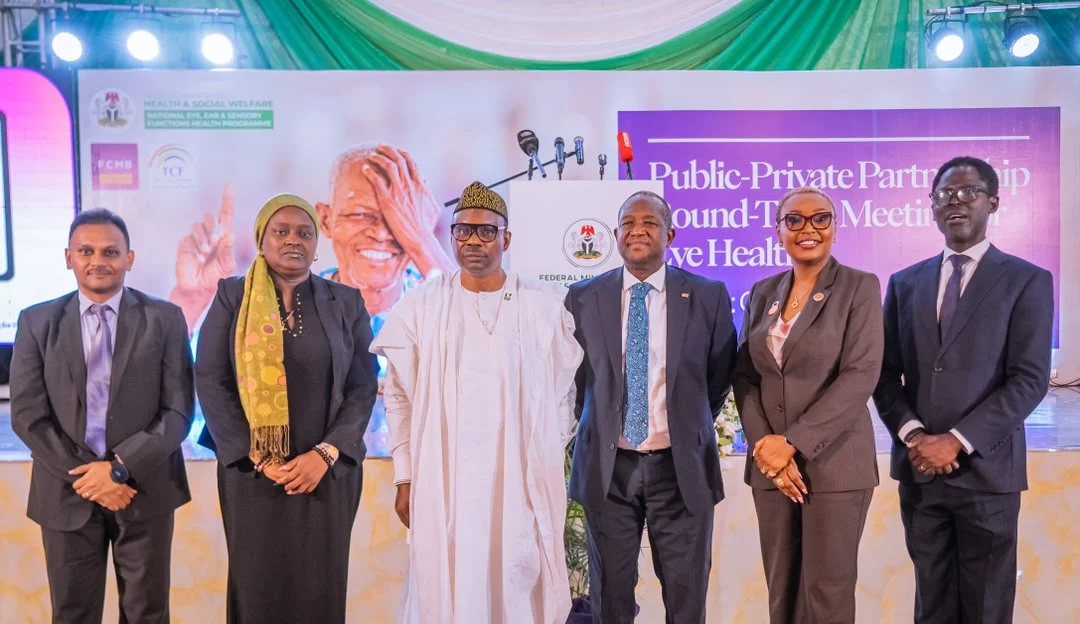
The Nigerian Government has called for increased private-sector investment in the local production of optical lenses, spectacle frames, eye drops and other essential eye-care products to reduce Nigeria’s dependence on imports.
The Minister of State for Health and Social Welfare, Dr Iziaq Salako, made the call on Tuesday in Abuja at a Public-Private Sector Roundtable on Eye Health, with the theme, “Gift of Sight: Mobilising Partnerships and Sustainable Funding towards Transforming Eye Care in Nigeria.”
Salako said Nigeria could no longer depend heavily on imported products and external funding to meet its growing eye-health needs, noting that more than 90 per cent of basic optical consumables were currently imported.
He said strengthening domestic production would make essential eye-care products more affordable, create jobs and support the development of local supply chains.
“Our conversation here today, in line with our eye care strategic direction, is to further underscore that vision is not merely a health issue, but a fundamental driver of economic output,” Salako said.
The minister also urged investors to explore the local manufacture of essential ophthalmic medicines, particularly anti-glaucoma drugs and specialised post-surgical treatments.
“Access to affordable, high-quality ophthalmic medicines, from simple anti-glaucoma drops to specialised post-surgical therapies, remains sub-optimal.
“These are areas for domestic manufacturing through local formulation and production of essential eye medications under strict quality standards,” he said.
Salako said an estimated 24 million Nigerians were living with vision loss, much of which was linked to preventable or treatable conditions such as digital eye strain, cataracts, glaucoma and uncorrected refractive errors.
He said the government was implementing various measures to expand access to eye-care services nationwide.
According to him, the JigiBola 2.0 initiative has provided more than two million free eye screenings and 1.5 million spectacles in just over one year.
He added that more than 2,200 primary healthcare workers had been trained, while over 800 Primary Health Care Centres had been activated across 16 states.
Salako said the next phase of the programme would extend services to more than one million Nigerians in 10 additional states.
He also said the Federal Government, through Renewed Hope Health Connect, was targeting 25,000 free cataract surgeries by 2027.
READ ALSO: Experts Call for Homegrown AI Solutions in Healthcare
The National Coordinator, National Eye, Ear and Sensory Functions Health Programme, Dr Oteri Okolo, stressed the importance of integrating eye care into the primary healthcare system to improve access for people in rural communities.
Okolo, however, called for greater private-sector participation to complement government efforts and extend eye-care services to more Nigerians.
The Managing Director of First City Monument Bank (FCMB), Mrs Yemisi Edun, said the bank’s partnership with Tulsi Chanrai Foundation had demonstrated the impact of sustained private-sector involvement in eye health.
Represented by the bank’s Senior Vice President, Corporate Affairs, Mr Diran Olojo, Edun said the Priceless Gift of Sight initiative, launched in 2009, had provided free eye-care services to more than 400,000 Nigerians as of July 2024.
She said the initiative had covered eye examinations, optical services, surgeries and disease management.
Edun said the roundtable was aimed at translating shared concerns about vision loss into practical interventions supported by sustainable funding, defined responsibilities and measurable outcomes.
She stressed the need to move beyond one-off screening exercises to sustainable eye-care services supported by adequate personnel, equipment, maintenance and effective referral systems.
The Chief Executive Officer of Tulsi Chanrai Foundation, Shravan Kumar, said sustained partnerships and investment in eye health could deliver immediate benefits to individuals, families and the wider economy.
“With eye health, you can get the best investment because you will immediately see the returns.
“Once the surgery is done, once the spectacle is given, you can see a world of difference from the beneficiary, from their immediate family and friends,” Kumar said.
The Country Director of Sightsavers Nigeria, Prof. Joy Shuaibu, said 4.2 million Nigerians aged 40 years and above were blind or visually impaired, including 1.1 million adults.
She said, however, that 84 per cent of blindness was avoidable.
According to Shuaibu, cataracts accounted for 43 per cent of blindness and could be treated through a relatively simple surgical procedure, but only 4.4 per cent of Nigerians had access to quality eye-care services.
She called for stronger collaboration among government, the private sector, civil society, professional bodies, academia and development partners to achieve sustainable improvements in eye health.
