
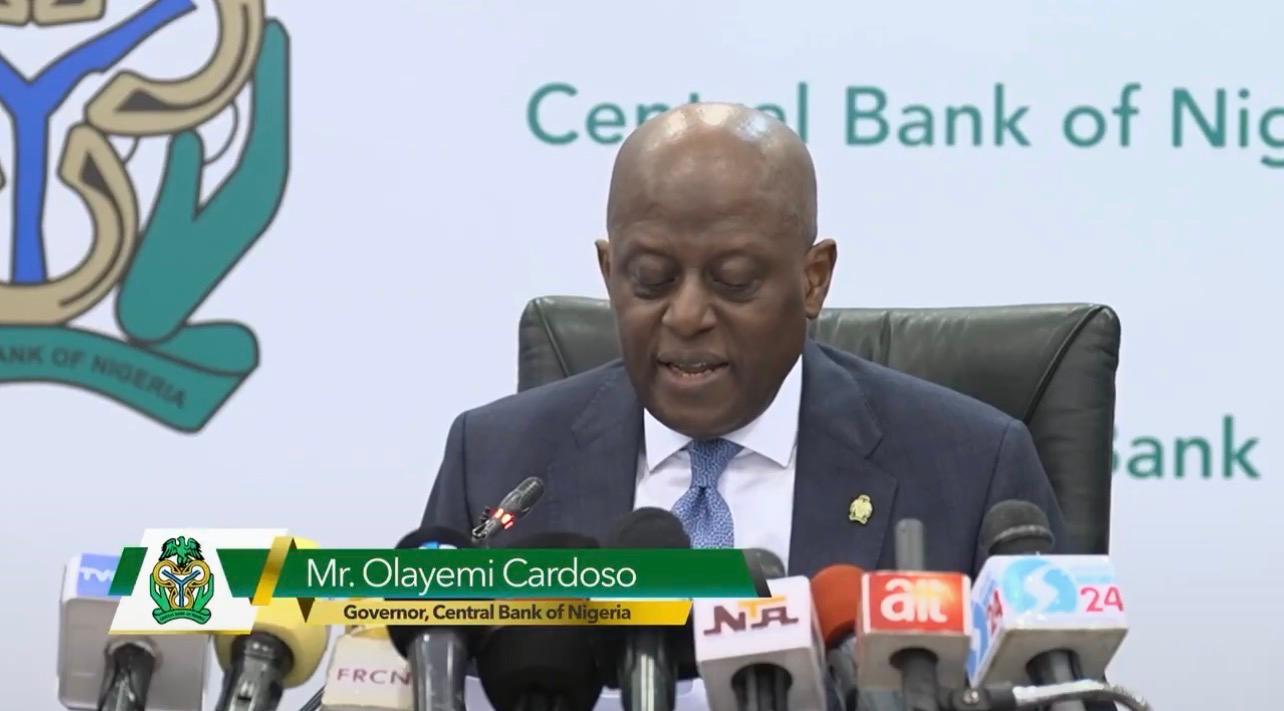
The Central Bank of Nigeria (CBN) has said it will keep its benchmark interest rate unchanged at 26.5 per cent, and retain the Cash Reserve Requirement for deposit money banks at 45 per cent and merchant banks at 16 per cent.
The decision came at the 305th meeting of the Monetary Policy Committee (MPC) of the CBN.
The CBN governor, Olayemi Cardoso, in a statement explained that the decisions were taken after the Committee reviewed recent developments in the global and domestic economies and assessed the near-to-medium-term outlook.
“The decisions of the MPC were anchored on a comprehensive assessment of risks to the outlook. Although inflation has risen marginally for two consecutive months, largely induced by external shocks, the MPC recognized its transitory nature and remained confident that the current macroeconomic environment is sufficiently robust to support a return to disinflation.” Cardoso said,
While noting the effects of the Middle East crisis, which have exerted upward pressure on energy prices, cost of transportation and other logistics, the MPC observed that available evidence indicates that the impact of the crisis on the Nigerian economy has been largely muted due to the benefits of prior policy reforms.
Cardoso said, “These include exchange rate stability, improvements in external reserve buffers, strengthened monetary policy transmission, a well-capitalised banking system, and ongoing fiscal consolidation, which have significantly bolstered the economy’s ability to absorb external shocks. As a result, the pass-through of global commodity and energy price shocks to domestic inflation has been significantly mitigated and would have been more pronounced in the absence of these reforms. The MPC was, therefore, convinced that the essential conditions for price stability remain firmly in place.”
In addition, the Committee welcomed the recent sovereign rating upgrade amid prevailing external headwinds.
The CBN Boss said that this further underscores the strength of the country’s macroeconomic fundamentals and reinforces confidence in its reform trajectory and policy credibility, leading to the MPC members proposing a cautious and vigilant policy stance in order to anchor inflation expectations and safeguard macroeconomic stability.
Cardoso also highlighted the significance of the just-concluded recapitalisation exercise, noting that the successful conclusion of the banking recapitalisation exercise culminated in the emergence of 33 banks with stronger financial soundness indicators, enhancing their capacity to support the economy.
The MPC then urged the Bank to remain proactive and adopt necessary measures to address potential post-recapitalisation risks towards preserving financial system stability.
Inflation
The nation’s Headline inflation rose marginally for the second consecutive month to 15.69 per cent in April 2026, from 15.38 per cent in the preceding month, largely driven by the rise in food inflation to 16.06 per cent in April 2026 from 14.31 per cent in March.
Despite the rise in inflation, the MPC noted some very strong buffers that have continued to reinforce investor confidence in the Nigerian economy and support exchange rate stability.
These include the moderation of core inflation to 15.86 per cent in April 2026, from 16.21 per cent in March, and the slowing of the 12-month average inflation to 19.16 per cent in April 2026, from 20.05 per cent in March.
Also, looking at the Month‑on‑month headline inflation, this also eased to 2.13 per cent in April 2026, compared with 4.18 per cent in March2026, reflecting moderation in both food and core components.
Other positive buffers according to the committee are the growth of the real GDP by 4.07 per cent in the fourth quarter of 2025, compared with 3.98 per cent in the preceding quarter, supported by expansion in industry and agriculture sectors.
A close look at the GDP shows that the non-oil sector grew by 3.99 per cent (year-on-year) in Q4 2025 from 3.91 per cent in the preceding quarter, driven by key activities in the Services sector, including information & communication, and transportation & storage activities.
The oil sector also tapped into the growth trajectory, rising to 6.79 per cent in Q4 2025 from 5.84 per cent in the previous quarter, on the back of improved refining in the downstream sector.
Gross external reserves remained robust at US$49.49 billion as of 15th May 2026, compared with US$48.35 billion at end‑March 2026, sufficient to cover 9.04 months of imports for goods and services.
Global growth is expected to moderate in 2026 compared with 2025, reflecting the impact of heightened geopolitical tensions, energy market disruptions, and tighter financial conditions.
