
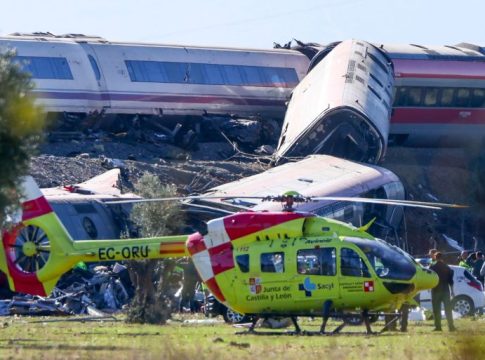
Rescue workers in Spain have continued searching the wreckage of two high-speed trains involved in a collision in the central province of Toledo, as the death toll rose to 69, prompting renewed calls for answers over the country’s rail safety.
Cranes worked through the night on Thursday to lift sections of the mangled carriages from the crash site, while emergency personnel recovered what appeared to be a body wrapped in a blanket from one of the trains.
Regional leader Emiliano García-Page confirmed that the number of fatalities had risen to 69, adding that human remains had been found during the rescue operation, particularly around a carriage that remained overturned.
Among those killed was Fátima Báñez, a former Spanish Labour Minister who chaired the social and corporate responsibility arm of the country’s employers’ association.
Spain’s Foreign Ministry said preliminary information indicated that 42 foreign nationals from seven countries were involved in the crash. One had been confirmed dead, while at least seven others were injured.
Authorities said 57 injured passengers remained in hospital.
The accident, Europe’s deadliest train disaster since the 2013 derailment in Santiago de Compostela, has intensified concerns over safety on Spain’s railway network, the longest high-speed system in Europe.
As the public demanded explanations, train drivers proceeded with a previously scheduled strike to press for increased investment in railway safety.
Diego Martín of the train drivers’ union, SEMAF, said the union would continue to demand measures to restore safety standards across the sector.
He said the railway system must have all the necessary safety equipment to maintain its established standards, adding that such accidents must not be allowed to happen again.
State-owned rail operator Renfe said the strike had caused significant disruption to services. It offered passengers the option of changing or cancelling tickets free of charge and said those affected would be notified.
The crash, which followed another fatal accident in January involving the same rail companies on the same line, has also disrupted campaigning ahead of Spain’s November 29 snap election.
The leaders of the country’s two main political parties suspended their campaign activities following the incident.
The Spanish Government declared three days of national mourning for the victims.
READ ALSO: Eastern Slovakia Train Crash Leaves 20+ Injured
Transport Minister Óscar Puente said the crash occurred after several trains stopped following a signal failure. He explained that a Renfe train was subsequently authorised to proceed at normal speed, despite an Iryo-operated train being stationary ahead.
Railway unions blamed inadequate funding and a lack of political commitment to improving safety, saying discussions with the government following January’s accident had been abandoned in April.
Puente, however, rejected criticism of the country’s railway system, describing it as reliable and safe, while acknowledging the limitations of equipment and human actions in all forms of transport.
The government described the decision to authorise the Renfe train to continue its journey as inexplicable.
Pope Leo sent condolences to the families of those killed and wished the injured a speedy recovery, the Vatican said. He also expressed support for those affected and encouraged rescue workers to continue their efforts.
Spain’s Interior Ministry said more than 800 military and police personnel had been deployed to the crash site, alongside over 200 vehicles, three helicopters, drones, search dogs and other emergency resources.
A judge in Toledo imposed a two-kilometre exclusion zone in both directions along the Madrid-Seville high-speed rail line, restricting access to emergency, security, healthcare and judicial personnel.
Prime Minister Pedro Sánchez, who visited Toledo, said authorities were working round the clock to support victims and their families and establish the full circumstances of the accident.
Meanwhile, Alberto Núñez Feijóo, leader of the centre-right People’s Party, visited Urda, where residents had joined rescue efforts after the collision.
