
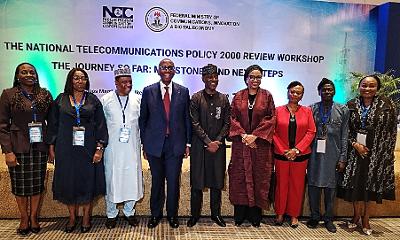
The Nigerian government, through the Nigerian Communications Commission (NCC), has commenced a review of the National Telecommunications Policy 2000, noting that Nigeria’s rapidly expanding digital economy has outgrown the framework that guided the liberalisation of the sector over two decades ago.
Speaking at a policy review workshop in Lagos, the Executive Vice Chairman and Chief Executive Officer of the NCC, Aminu Maida, said the exercise was aimed at developing a modern telecommunications policy that reflects emerging technologies and Nigeria’s broader digital ambitions.
“This Workshop is not merely a gathering of experts and industry participants. It is a strategic national conversation on the future of Nigeria’s telecommunications and digital ecosystem,” Maida said.
He noted that when the policy was introduced in 2000, Nigeria’s telecom sector was dominated by the defunct NITEL and had fewer than 500,000 active telephone lines for a population of over 120 million people, but reforms later opened the market to private investment, competition and rapid network expansion.
According to him, the sector has now evolved beyond basic connectivity into a critical driver of banking, fintech, education, healthcare, e-commerce and government services.
“Telecommunications is no longer just one sector within the economy; it is productivity infrastructure for the entire economy.”
Maida said the industry is currently facing new realities involving 5G, artificial intelligence, satellite broadband, cloud infrastructure, cybersecurity and digital trust, alongside persistent challenges such as fibre cuts, vandalism, high energy costs, multiple taxation and rural connectivity gaps.
He stressed that the proposed National Telecommunications Policy 2026 would retain key principles such as competition, universal access and consumer protection while supporting broadband expansion, innovation and sustainable investment.
“Our task is to preserve the enduring principles of competition, universal access, independent regulation and consumer protection, while developing a modern policy framework that supports broadband expansion, innovation, investment and resilience.”
The NCC boss also cited estimates by the GSMA showing that deeper digitalisation across key sectors of the economy could boost Nigeria’s GDP, create nearly two million jobs and increase tax revenue by about ₦1.6 trillion by 2028.
He added that the workshop would produce recommendations for a forward-looking telecom policy focused on broadband infrastructure, cybersecurity, regulatory coordination, artificial intelligence, data protection and meaningful connectivity for Nigerians.
The NCC also highlighted the growing need for inter-agency collaboration involving institutions such as the Nigeria Data Protection Commission, Central Bank of Nigeria, Federal Competition and Consumer Protection Commission, National Information Technology Development Agency and National Identity Management Commission.
Maida said the workshop would assess the implementation of the existing telecom policy, identify gaps and challenges, and produce recommendations that will shape a forward-looking telecommunications framework for Nigeria’s digital future.
The Chairman of MTN Nigeria and former EVC of NCC, Ernest Ndukwe, described the move as timely, saying that telecommunications systems have advanced and evolved, hence the need for the review.
The workshop brought together government officials, regulators, industry leaders, development partners and policy experts to deliberate on the future of Nigeria’s telecom and digital ecosystem.
