
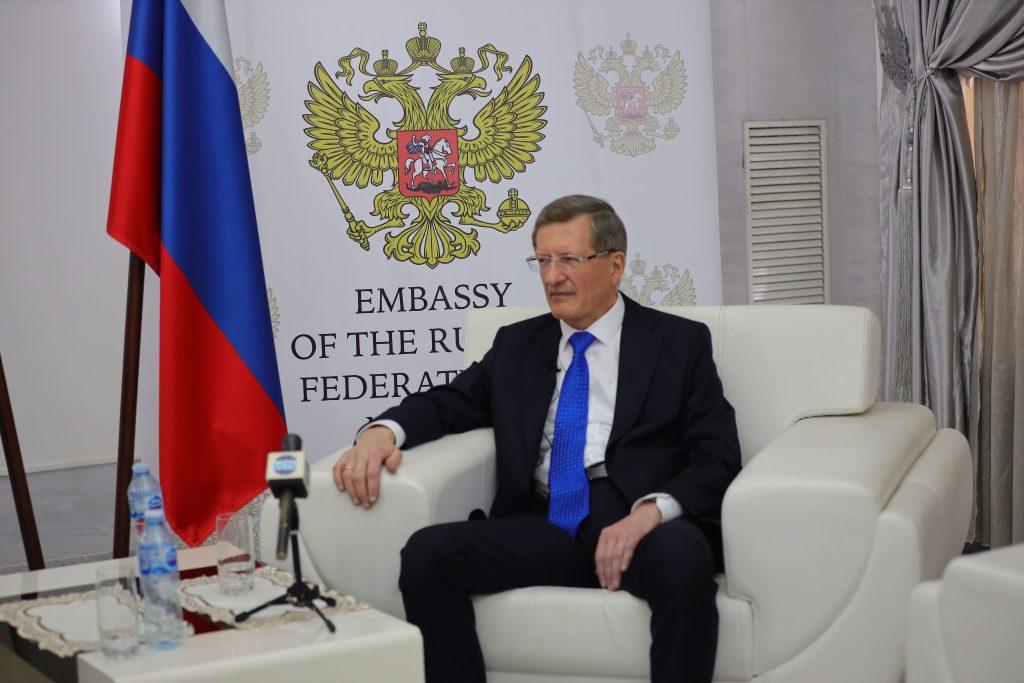
Russia’s Ambassador to Nigeria, Andrey Podelyshev, has reaffirmed Moscow’s commitment to providing continuous diplomatic support to Nigeria, particularly in the areas of regional stability and reform of the UN Security Council.
Speaking in an interview in Abuja, Ambassador Podelyshev noted that the two nations will later this year celebrate 65 years of diplomatic ties.
He described Nigeria as “a leading political and economic powerhouse in Africa, leveraging its comparative advantage in human and material resources to resolve crises on the continent while promoting peace and security.”
The envoy added that this aligns with Russia’s global outlook of “promoting territorial integrity, anchored on the right of nations to pursue their political and economic aspirations devoid of foreign interference and control.”
Historic Ties
Ambassador Podelyshev recalled that “this year, on November 25th, marks the 65th anniversary of the establishment of diplomatic relations between our two countries. The Soviet Union was among the first to recognise Nigeria’s independence.”
“Since then, a great deal has been accomplished, and a solid foundation for bilateral cooperation has been laid,” he said, adding that Moscow played a key role in preserving Nigeria’s unity during the civil war by providing crucial military assistance to the Federal Government.
He also highlighted the Soviet Union’s role in Nigeria’s post-war economic recovery, including the construction of the Ajaokuta Steel Mill in 1979, as well as educational and professional training opportunities that enabled “tens of thousands of Nigerians to receive higher education in the universities of the Soviet Union, and later in Russia.”
Renewed Diplomatic Engagement
Following the dissolution of the Soviet Union in the 1990s, Russia temporarily scaled back its engagement with Africa. But according to the Ambassador, Moscow has since made a full-scale return.
“This commitment is evidenced by the two Russia–Africa Summits the first held in Sochi in 2019 and the second in St. Petersburg in 2023,” he said. “At the second Russia–Africa Summit, Nigeria was represented by a high-level delegation led by Vice President H.E. Kashim Shettima. The Summit concluded with the adoption of the Russia–Africa Partnership Forum Action Plan for 2023–2026.”
The Ambassador also recalled several high-level visits between both nations since 2001, emphasising that “it is very important to maintain such an active political dialogue between our countries at different levels. I see it as my personal mission to fully contribute to this effort.”
Ambassador Podelyshev revealed that discussions between Moscow and Abuja have focused on expanding cooperation in trade, energy, infrastructure, agriculture, and mineral processing.
“The Foreign Ministers held a comprehensive exchange of views on key issues on the global and African agenda, with a particular focus on the reform of the UN Security Council, the settlement of regional conflicts, and the situation in the Sahara–Sahel region,” he said.
Also Read: Russia Pledges Deeper Cooperation with Nigeria
He added that both nations also agreed to strengthen coordination within the United Nations and other multilateral platforms, while advancing decisions from the Second Russia–Africa Summit.
Reflecting on the first Russia–Africa Summit in Sochi, Podelyshev said it opened “a new chapter in the strategic partnership with Nigeria, setting long-term guidelines for its further deepening.”
He stressed that Nigeria’s global influence remains central to Russia’s cooperation strategy: “We view Nigeria as a locomotive of economic growth and political influence in the region and across the continent. Russia regards Nigeria as one of its principal partners in Africa and an advocate of the fundamental principles of international law on the continent.”
According to him, Abuja’s balanced foreign policy and opposition to unilateral sanctions demonstrate Nigeria’s leadership role in defending multilateralism and regional stability.
The Ambassador outlined Russia’s strategic priorities with Nigeria, which include trade, investment, agriculture, science and technology, energy, education, and cultural exchange.
He disclosed that agreements are being prepared on investment protection, criminal justice cooperation, education, outer space, electric power, and military-technical collaboration.
A major focus, he said, will be “the early resumption of the full-scale work of the Intergovernmental Russian–Nigerian Joint Commission on Economic, Scientific and Technical Cooperation, which is an important mechanism for coordinating bilateral interaction.”
“We will continue to welcome Nigerian youth to Russian universities, promote exchanges of delegations at different levels, and diversify cultural and humanitarian cooperation,” he promised.
Concluding, the Ambassador expressed confidence that “the consistent implementation of these priorities in the coming years will raise the Russian–Nigerian partnership to a new and even higher level.”
