
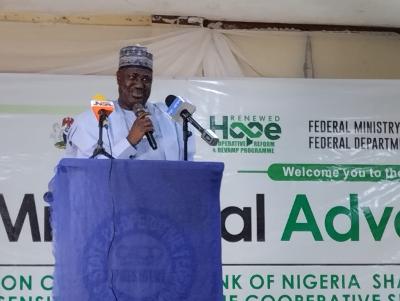
Nigeria’s Minister of State for Agriculture and Food Security and Supervising Minister of Cooperative Affairs, Aliyu Sabi Abdullahi, has flagged off the South-West Zonal Engagement of the Ministerial Advocacy Tour on the Cooperative Bank of Nigeria share capital mobilisation and the cooperative sector digitalisation drive.
The engagement is aimed at repositioning the cooperative sector as a major driver of inclusive economic growth, financial inclusion, enterprise development, food security, job creation, and poverty reduction, in line with President Bola Ahmed Tinubu’s Renewed Hope Agenda and the national aspiration of building a one-trillion-dollar economy.
Speaking during the event held at LASCOFED Multipurpose Hall in Ikeja, Lagos, the minister said the event marked the formal commencement of two major initiatives under the Renewed Hope Cooperative Reform and Revamp Programme (RH-CRRP) 2025–2030, as approved at the 8th Regular Meeting of the National Council on Cooperative Affairs (NCCA) in March 2026.
Senator Abdullahi stated: “Commencing this tour in the South-West is a symbolic return to the roots of the cooperative movement in Nigeria. This is where it all began in 1937 with Gbedun Cooperative, and it is fitting that we relaunch our reform agenda here.”
He revealed that the event also marked the commencement of nationwide sensitisation for the establishment of the Cooperative Bank of Nigeria, designed to provide accessible and affordable financial services to cooperators, farmers, artisans, traders, SMEs, youths, women, and persons with special needs.
Senator Abdullahi noted that, to avoid past pitfalls where cooperative banks lost their identity, the new bank has a deliberate ownership structure:
- 65 per cent controlling equity: Reserved for cooperative societies, unions, federations, and individual cooperators to preserve cooperative identity and control.
- 30 per cent non-controlling equity: Open to private institutional investors, development finance institutions, impact investors, and qualified individuals.
- 5 per cent equity participation: Reserved for employees of the bank and affiliated cooperative enterprises to ensure institutional commitment.
He emphasised that the initiative is government-enabled but not government-funded, with no Treasury Single Account (TSA) funds involved.
Addressing the lack of credible data in the sector, Dr Abdullahi also revealed that the ministry is introducing two foundational digital identity systems:
- Cooperative Verification Number (CVN): Assigned to every registered cooperative society to verify genuine cooperatives, eliminate ghost societies, improve regulation, and boost investor confidence.
- Cooperative Members Identification Number (CoopID): Issued to every cooperator in Nigeria to enhance financial inclusion, traceability, and access to financing.
He added that both systems would be integrated with the National Identity Number (NIN) architecture to harmonise with national data systems and serve as the data backbone for the proposed Cooperative Bank.

The minister outlined the seven pillars of the RH-CRRP 2025–2030, covering cooperative governance and institutional reforms; cooperative financing and the establishment of the Cooperative Bank of Nigeria; cooperative sector digitalisation and data management systems; capacity building, cooperative education, and human capital development.
Other pillars include value chain development, enterprise growth and market access; youth, women, and persons with special needs inclusion and empowerment; and strategic partnerships, investments, and global cooperative competitiveness.
He added that the South-West also pioneered the Cooperative Bank of Western Nigeria, further underscoring the region’s legacy in cooperative finance.
He urged cooperative leaders to mobilise members for the digitalisation process, called on investors and development partners to view the initiative as a long-term national economic transformation platform, and charged cooperators to “reclaim the strength, relevance, and economic power of the cooperative movement in Nigeria.”
In her remarks, the Commissioner for Commerce, Cooperatives, Trade and Investment, Folashade Ambrose-Medebem, noted that cooperatives are not relics of the past but strategic institutions for the future.
She stated that globally, more than one billion people are members of cooperatives, while the top 300 cooperatives generate over two trillion dollars annually and drive substantial shares of agricultural production, housing finance, retail distribution, and community banking.
During his vote of thanks, the Federal Director of the Cooperatives Department, Mohammed Bashir Abdulkadir, said the day’s discussions reaffirmed the bright future of the cooperative movement.
He lauded Senator Abdullahi for his commitment to repositioning the cooperative sector under the RH-CRRP and thanked the Lagos State Government and other stakeholders for the successful flag-off of the South-West Ministerial Tour.
