
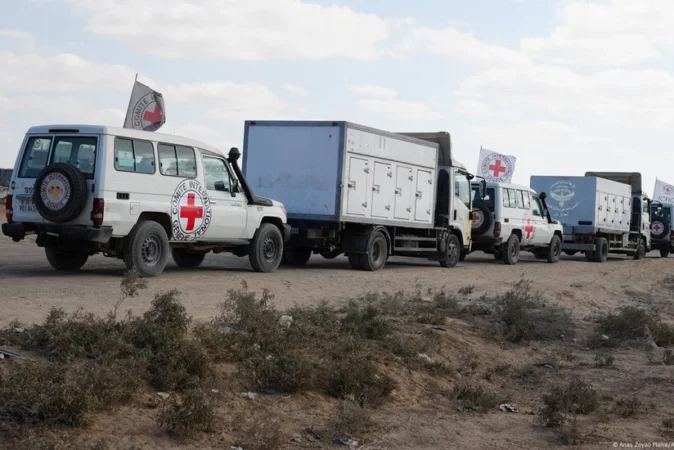
Palestinian militant group Hamas on Thursday handed over the bodies of two deceased Israeli hostages to the International Committee of the Red Cross in Gaza, amid growing tension following renewed Israeli airstrikes across the enclave.
Israeli Prime Minister Benjamin Netanyahu’s office confirmed that the remains had been received by Israeli forces and would be transported for identification.
Under the U.S.-brokered ceasefire accord, Hamas agreed to release all living hostages in exchange for nearly 2,000 Palestinian prisoners and detainees, while Israel suspended its offensive and allowed more humanitarian aid into Gaza. The group also pledged to return the remains of 28 hostages in exchange for 360 Palestinian militants killed in the war. So far, 15 bodies have been handed over.
Israel has accused Hamas of delaying the release of remaining bodies, while the militant group says it needs time to locate and recover all remains buried beneath the widespread devastation in Gaza.
Families of the deceased hostages have pleaded for the recovery of their loved ones’ remains, fearing they may be lost forever amid the rubble. Thousands of Palestinians are still missing and presumed dead following months of conflict.
Also Read: Israel, Hamas Seal Trump Peace Deal
The dispute over the handover of bodies has emerged as a key obstacle to U.S. President Donald Trump’s efforts to secure a lasting end to the Gaza war.
Tensions escalated again this week after Israel launched retaliatory strikes following the death of an Israeli soldier in a Palestinian attack. Gaza health officials reported that 104 people, including 46 children and 20 women, were killed in the bombardments.
Witnesses said Israeli aircraft carried out fresh strikes early Thursday in the southern city of Khan Younis and near Gaza City, while tanks shelled nearby areas. The Israeli military said the attacks targeted “terrorist infrastructure” threatening its troops.
Civilians in Gaza have expressed renewed fears of war resuming. “We’re scared another war will break out,” said Fathi Al-Najjar, a displaced resident in Khan Younis. “We’ve suffered two years of displacement. We don’t know where to go anymore.”
The war has displaced most of Gaza’s more than two million people, many of whom have been forced to move repeatedly as hostilities persist.
