
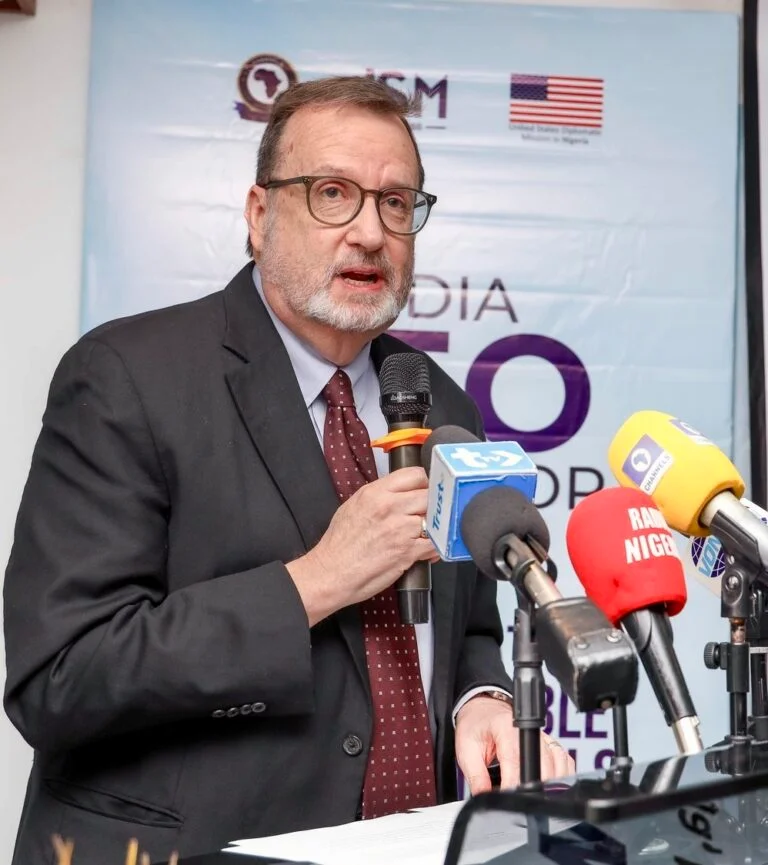
The envoys of the United States, United Kingdom, Finland, Norway, and Canada to Nigeria on Thursday congratulated Nigeria and its citizens on 26 years of democratic governance and called for a review of the Cybercrimes (Prohibition, Prevention, etc.) Act 2015.
The diplomats expressed their goodwill to Nigeria and its people in a joint statement signed by the U.S. Ambassador, Richard Mills; British High Commissioner, Richard Montgomery; Finnish Ambassador, Sanna Selin; Norwegian Ambassador, Svein Baera; and Canadian High Commissioner, Pasquale Salvaggio.
According to them, healthy democracies are built on key principles, and freedom of expression has long been a core value of Nigeria’s democratic culture.
The envoys noted that while commemorating 25 years of democracy in 2024, President Bola Tinubu had emphasised that “there must be diverse perspectives and viewpoints” in Nigeria.
“Nigeria’s constitution enshrines the right to freedom of expression, aiming to protect citizens’ rights and foster a society where people can debate and discuss ideas free from government control.
“This right the principle of trusting ordinary citizens to engage in open discussion in the virtual public square remains vital today,” they said.
The five envoys, however, called for a review of the Cybercrimes (Prohibition, Prevention, etc.) Act 2015, as amended in 2024, and warned against its potential impact on free expression.
They stated that misuse of the Act could undermine democratic progress, civic participation, investor confidence, and deter the innovation essential for economic growth.
Also Read: 2022, the ECOWAS Court of Justice ruled that the Act does not conform with Nigeria’s obligations regarding freedom of expression under the African Charter on Human and Peoples’ Rights and the International Covenant on Civil and Political Rights.
“Originally intended to tackle online fraud and cyberterrorism, the Act can be misused as a tool to suppress free expression and democratic engagement.
“Such misuse may discourage citizens from speaking out, weaken democratic accountability, and erode trust in government,” the diplomats added.
Nevertheless, they welcomed the Minister of Information’s commitment to working with the National Assembly and relevant stakeholders to review the Act, ensuring it aligns with the values enshrined in Nigeria’s constitution.
They further noted that the implications of amending the Act go beyond freedom of expression, adding that Nigeria’s economic future hinges on its capacity to innovate and attract digital-age investment.
“The Nigerian Communications Commission (NCC) estimates that the country loses $500 million annually to cybercrime. This issue requires a firm and effective response.
“However, the Cybercrimes Act’s broad language particularly the vague definitions of ‘false information’, ‘cyberstalking’, ‘harassment’, and ‘insult’ creates room for confusion and potential abuse.
“If misapplied, even in a few cases, the Act risks discouraging the very innovators and entrepreneurs the government hopes to attract to Nigeria,” they warned.
The ambassadors also urged Nigerian lawmakers to consider narrowing the definitions of key terms such as “false information,” “cyberstalking,” “insult,” “hatred,” and “harassment” in the legislation.
“As friends of Nigeria who share its strong commitment to democratic values, we want the country to realise its full potential as a democratic digital powerhouse.
“Striking this balance will be challenging, but it is essential to deliver what Nigerians desire an open and stable democracy, and economic growth driven by investment.
“Nigeria is not alone in facing this challenge. Democracies worldwide are contending with the ever-evolving risks and opportunities presented by the digital age,” the envoys concluded.
