
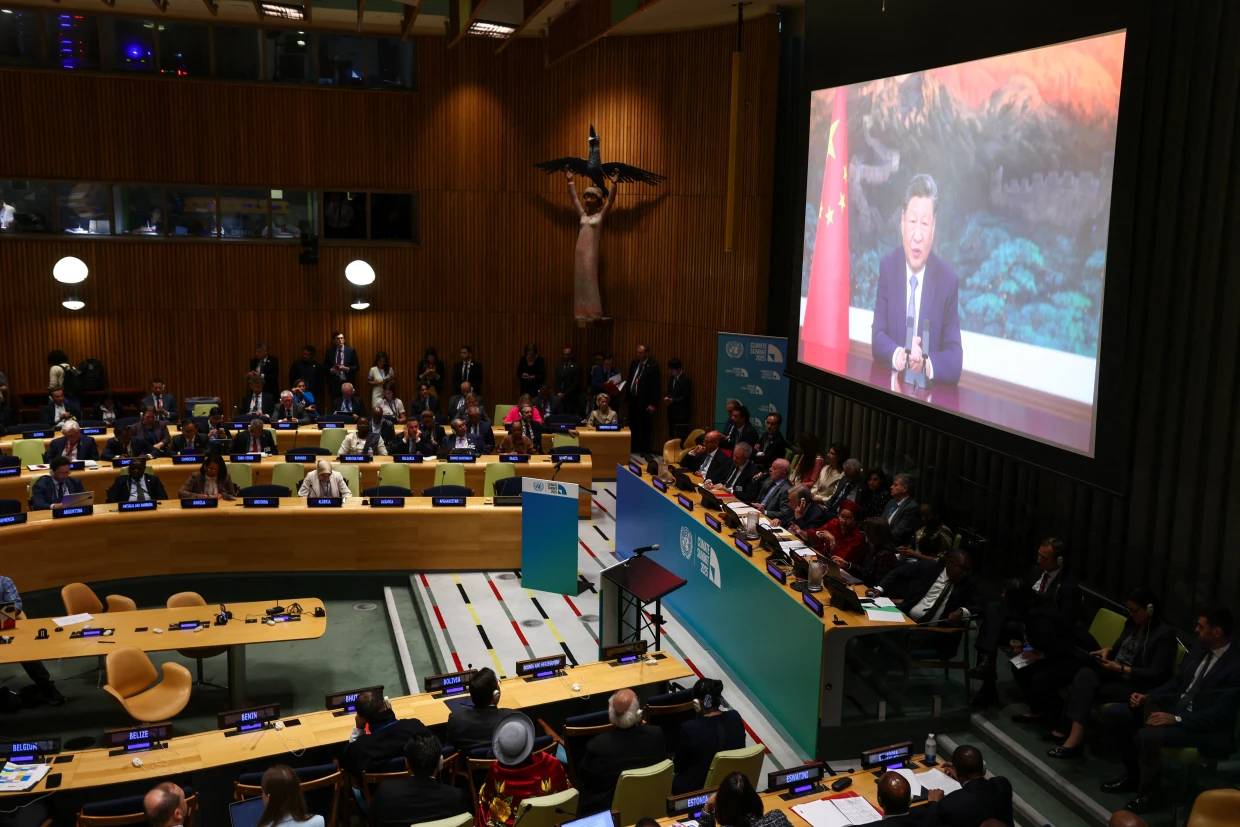
China on Wednesday announced new climate commitments at a U.N. climate leaders’ summit in New York, pledging to cut greenhouse gas emissions by 7–10% from peak levels by 2035 and sharply expand renewable energy.
President Xi Jinping, speaking via video link from Beijing, said China would increase its wind and solar power capacity sixfold from 2020 levels over the next decade, boosting non-fossil fuels to more than 30% of national energy consumption. It marked the first time the world’s largest emitter committed to an outright reduction in emissions rather than only limiting their growth.
Xi’s remarks included a veiled criticism of U.S. President Donald Trump, who a day earlier had denounced climate change as a “con job” during his U.N. General Assembly address. “Green and low-carbon transformation is the trend of our times. Despite some countries going against the trend, the international community should stay on the right track,” Xi said.
The announcement was welcomed as a symbolic step but fell short of expectations. Analysts and environmental groups had hoped Beijing would commit to deeper cuts of around 30% to align with its long-term net-zero pledge for 2060. Li Shuo of the Asia Society’s China Climate Hub described the move as “cautious,” noting it reflected China’s steady decision-making but also masked the scale of its economic advances in green technology.
Other countries also outlined new targets ahead of November’s COP30 summit in Brazil. President Luis Inacio Lula da Silva pledged Brazil would cut emissions by 59–67% by 2035 and intensify anti-deforestation efforts, warning that weak pledges would erode public trust.
Australia committed to a 62–70% reduction from 2005 levels by 2035, while the European Union signalled a target range of 66–72% by that year. The island nation of Palau, representing the Alliance of Small Island States, vowed a 44% reduction from 2015 levels by 2035 and urged industrialised nations to shoulder greater responsibility.
U.N. Secretary-General Antonio Guterres acknowledged that progress since the 2015 Paris Agreement had lowered projected global warming but stressed the urgency of stronger measures. “Now, we need new plans for 2035 that go much further, much faster,” he said.
Despite Wednesday’s pledges, climate advocates said the world remains far off track to meet the Paris goal of limiting warming to 1.5°C. The planet has already heated more than 1.2°C above preindustrial levels.
