
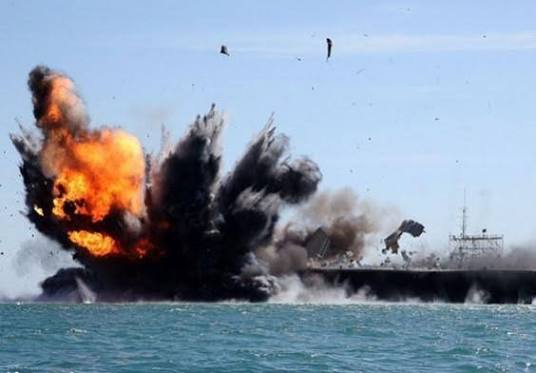
Iran said on Friday it had launched fresh attacks on United States military facilities in the Gulf following a sixth consecutive night of American airstrikes on Iranian military targets, raising fears of a further escalation in the conflict despite last month’s ceasefire.
The United States military said it carried out another round of strikes aimed at weakening Iran’s military capabilities, targeting sites on Qeshm Island and near Bandar Abbas, home to Iran’s largest port and major naval and Revolutionary Guards facilities.
In a statement, the U.S. Central Command said: “U.S. forces, including fighter jets, aerial drones, and warships, launched precision munitions that hit dozens of Iranian military targets such as coastal surveillance and air defence sites, military logistics infrastructure, and maritime capabilities.”
Iran has responded by launching missiles and drones at U.S. military bases in neighbouring countries. In the early hours of Friday, Iran’s military said it had attacked U.S. facilities in Bahrain and Kuwait.
Several explosion-like sounds were also reported in Qatar’s capital, Doha, while the country’s Ministry of the Interior said a child was injured by shrapnel.
READ ALSO: Peace Talks Stall as US–Iran Conflict Drags On
Iranian media reported that the latest U.S. strikes also hit five bridges, Bandar Khamir railway station and Iranshahr Airport in south-eastern Iran.
State news agency IRNA said seven people were killed in attacks on bridges in the southern port city of Bandar Khamir. Reuters said it could not immediately verify the reports.
The renewed hostilities have once again disrupted shipping through the Strait of Hormuz, the world’s most important route for oil and gas exports, pushing global energy prices higher.
Iran has resumed its blockade of the strategic waterway, while Washington has again imposed a blockade on Iranian ports.
Sources told Reuters that Tehran has also signalled it could encourage its Houthi allies in Yemen to block the Bab al-Mandeb Strait at the entrance to the Red Sea if the United States expands attacks on Iranian infrastructure.
Last week, Iran targeted vessels transiting a shipping corridor in the Strait of Hormuz.
Responding to the latest developments, White House Press Secretary Karoline Leavitt said President Donald Trump would not “sit by and allow these active acts of terrorism to take place in the strait without ensuring Iran pays consequences for that.”
She, however, added that the president was “always open to diplomacy at the very same time.”
According to Reuters, Iranian officials said Tehran’s objective was to assert greater authority over the Strait of Hormuz, although it was not seeking an escalation that could undermine the memorandum of understanding reached in June.
The renewed fighting has also heightened anxiety among residents inside Iran.
“Living with this fear that war could start again is very exhausting. You cannot live like this… Personally, I want diplomacy to prevail,“ Mahlegha, a 46-year-old government employee in Tehran, told Reuters.
Iran has also insisted it will maintain control over the Strait of Hormuz. Under proposals announced by Tehran, all vessels using the waterway would be required to pass through a channel close to Iran’s coastline, with passage fees to be introduced after a 60-day negotiation period outlined in last month’s agreement.
Meanwhile, President Trump has not ruled out deploying ground forces, including a possible operation to seize Kharg Island, Iran’s principal oil export terminal. He has also repeated threats to target Iranian power plants and bridges unless Tehran returns to negotiations.
