
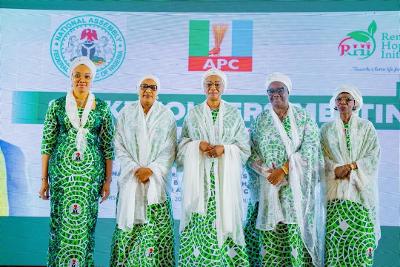
Nigeria’s First Lady, Senator Oluremi Tinubu, has unveiled a N110 million empowerment package for elderly citizens and persons with disabilities under the Renewed Hope Initiative (RHI), with 500 beneficiaries expected in each senatorial district.
The intervention comprises two programmes, each allocated N55 million, with 250 beneficiaries receiving N200,000 apiece under each scheme.
The First Lady announced the package at a stakeholders’ meeting attended by the All Progressives Congress (APC) National Chairman, Prof. Nentawe Yilwatda; Senate President Godswill Akpabio; Speaker of the House of Representatives, Tajudeen Abbas; serving and incoming senators; APC senatorial candidates; and members of the RHI Governing Board.
Under the RHI Economic Empowerment Programme for Persons with Disabilities, 250 beneficiaries in each senatorial district will receive N200,000 each.
The RHI Elderly Support Scheme will also provide N200,000 to 250 elderly citizens in each senatorial district.
Mrs Tinubu urged APC senatorial candidates to oversee the implementation of the programmes and ensure that the funds reach deserving beneficiaries, irrespective of their political affiliations.
She said the decision to work through senatorial candidates followed consultations with political leaders on the most effective way to coordinate the intervention and ensure that it achieved its objectives.
According to her, the candidates’ knowledge of their constituencies would help them identify vulnerable residents and facilitate the distribution of the support.
“We don’t say give it only to party members, but give it to your voters,” she told the candidates, stressing the need to ensure that deserving people benefited from the initiative.
The First Lady said the intervention reflected her longstanding commitment to the welfare of vulnerable Nigerians, drawing on her experience in public service and empowerment programmes during her 12 years in the Senate.
She noted that the RHI had previously supported persons with disabilities and was expanding its efforts to provide further assistance to them. She added that the elderly support intervention had entered its fourth edition.
Mrs Tinubu said she had considered different approaches to implementing the programme, including working through state coordinators and traditional rulers, before consultations led to the adoption of the senatorial district model.
She said the arrangement would also increase awareness of the RHI’s programmes and improve their reach across the country.
Akpabio commended the First Lady for bringing together serving and incoming senators to coordinate the intervention, describing the meeting as an opportunity to strengthen the delivery of programmes for vulnerable Nigerians.
READ ALSO: Oluremi Tinubu Urges Global Support for Youth Empowerment
He said President Bola Tinubu had approved the arrangement, adding that the initiative was designed to extend support beyond party boundaries.
The Senate President urged the candidates to regard the responsibility as a public trust and ensure that elderly citizens and persons with disabilities in their constituencies benefited from the scheme.
He also cited the First Lady’s interventions for women, children and elderly citizens, saying the RHI had supported displaced communities, vulnerable households and women across the country over the past three years.
Akpabio encouraged the candidates to work with other APC political office-seekers in their districts to broaden the programme’s reach.
Abbas also commended the First Lady for her empowerment initiatives, saying the RHI’s monthly Food Outreach Programme had reached 31 states.
“On behalf of the House of Representatives, I want to say a big thank you to our mama for all the good things she is doing,” he said.
Yilwatda, in his remarks, said the RHI had reached vulnerable communities across the federation through food support, cash assistance and economic empowerment programmes.
He urged the senatorial candidates to involve party structures and other relevant stakeholders in implementing the intervention, while ensuring that beneficiary selection was not influenced by ethnicity, religion or political affiliation.
