
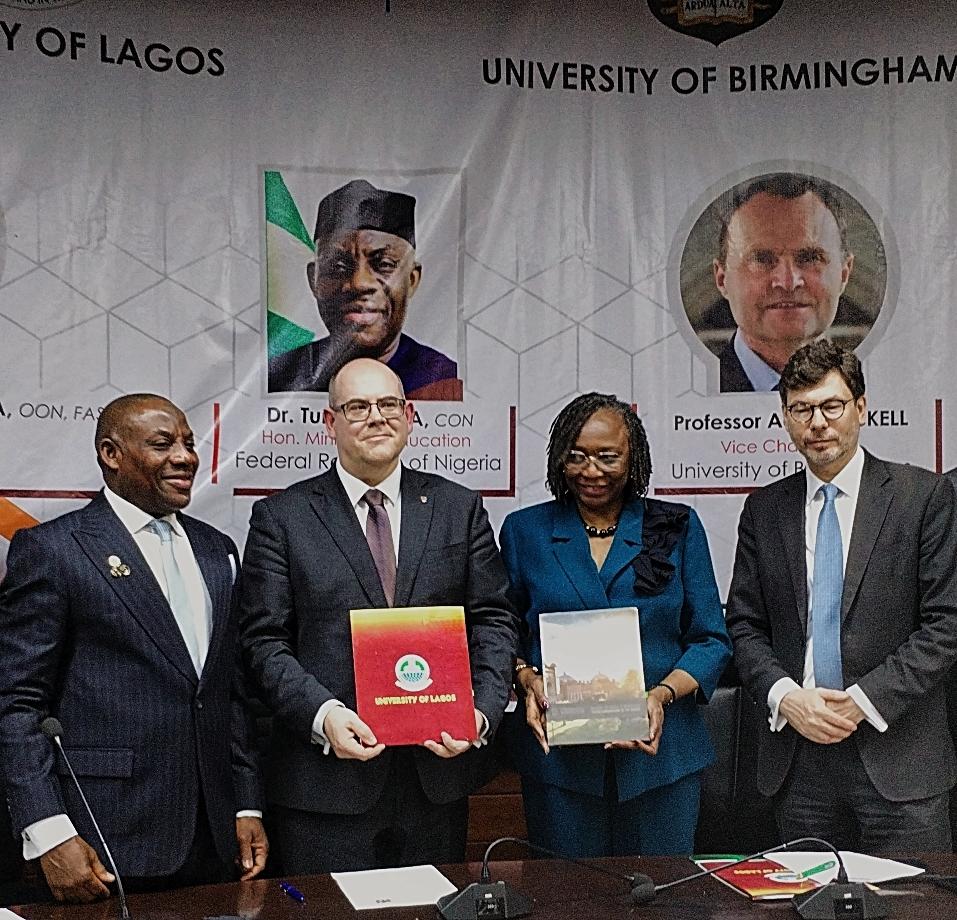
The University of Lagos (UNILAG) and the University of Birmingham, United Kingdom, have formalised a partnership aimed at expanding transnational education and strengthening research collaboration in Nigeria.
The Memorandum of Understanding (MoU) was signed in Lagos by Professor Nick Vaughan-Williams, Provost of the University of Birmingham, and Professor Folasade Ogunsola, Vice-Chancellor of UNILAG. The agreement will pave the way for the introduction of Birmingham-accredited academic programmes to be delivered locally in Nigeria.
Speaking at the signing ceremony, Nigeria’s Minister of Education, Dr Tunji Alausa, described the partnership as both timely and strategic, emphasising that it complements ongoing efforts to enhance tertiary education and broaden access to global learning opportunities.
“This collaboration reflects academic excellence, innovation, and global relevance. It demonstrates the Renewed Hope Agenda in practice, translating vision into tangible outcomes for students, institutions, and national development,” the minister stated.
The MoU outlines plans to establish a Transnational Education Unit in Lagos, with programme delivery targeted to begin in 2027, subject to regulatory approvals. Proposed fields include Applied Artificial Intelligence and Digital Communications and Media, designed to equip students with skills essential for the digital economy.
Professor Vaughan-Williams said the University of Birmingham was proud to strengthen its long-standing relationship with UNILAG, noting that the collaboration builds on more than a decade of joint research initiatives.
“We are committed to supporting Nigeria’s talent development and economic growth through education, research, and innovation. This partnership will contribute positively to society and prepare future nation builders,” he said.
Professor Ogunsola described the MoU as a historic milestone in Nigeria–UK academic relations, highlighting the potential of transnational education to provide students with access to globally relevant curricula without leaving the country.
“This partnership will produce graduates who are globally competent yet responsive to local needs. It opens new research frontiers and strengthens access to international academic networks,” she added.
The UK Deputy High Commissioner to Nigeria, Jonny Baxter, lauded the collaboration, noting that it reinforces UK–Nigeria efforts to enhance world-class education, research, and skills development in critical fields like Artificial Intelligence.
The University of Birmingham has also supported Nigeria through initiatives such as the Global Surgery Unit Nigeria Hub, renewable energy installations in teaching hospitals, and research on maternal healthcare and women’s lived experiences.
