
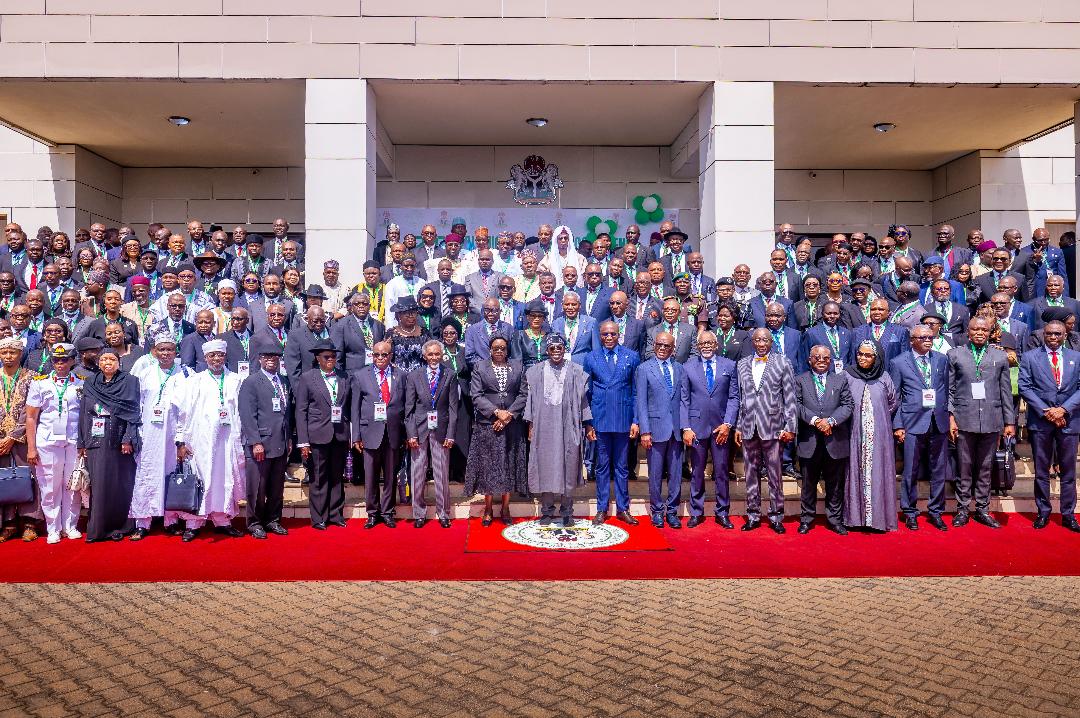
President Bola Ahmed Tinubu on Monday urged Nigerian judges to uphold the integrity of the judiciary and restore public confidence in the justice system, stressing that the moral authority of the courts depends on the perception of fairness and impartiality.
Speaking in Abuja while declaring open the 2025 All Nigerian Judges Conference at the National Judicial Institute, the President said the judiciary must remain conscious of how it is viewed by citizens, as this directly affects the stability of the nation’s democracy.
Tinubu described the conference theme, “Building a Confident Judiciary,” as particularly timely, noting that Nigerians have continued to express concerns about delays in the judicial process, questions around integrity, and challenges in accessing justice. He said: “Confidence is the lifeblood of justice. A judgment may be grounded in law and delivered with clarity, but unless the public perceives it to be fair, impartial, and untainted, its moral authority is diminished. The confidence of the people is, therefore, not an abstract aspiration. It is the living measure of the Judiciary’s legitimacy and the true currency of justice.”
He acknowledged that public perception of judicial processes has not always been positive, adding that such concerns, whether justified or not, must be addressed through reflection and reform. According to him, “Justice does not exist for the Bench or the Bar; it exists for the people. Their faith in the judicial process is the foundation of our national stability.”
Tinubu emphasised that the strength of the judicial system does not lie in physical structures or technology alone, but in the men and women responsible for interpreting the law. He said judges remain the custodians of justice and that judicial welfare, continuous training, and independence are essential to strengthening the system.
“Bricks and mortar, or even digital screens, do not make justice. The true strength of the Judiciary lies in the men and women who interpret the law and give life to its spirit. Our Judges are the living custodians of justice; the calibre of their work defines the moral strength of the Republic,” he said.
The President reaffirmed his administration’s commitment to supporting the judiciary, stressing that a strong, efficient, and uncompromising Bench is vital for Nigeria’s democracy. He said the government would continue to provide institutional and material support to ensure courts function effectively, reduce delays, and restore public trust.
“We cannot build a just society without a fearless and functional Judiciary. Our courts must no longer be places where cases languish for years. They must become beacons of efficiency,” he added.
Tinubu commended the judiciary for its historic role in defending constitutional order during moments of national uncertainty, acknowledging its courage in safeguarding justice and restraining tyranny. He also highlighted the importance of modernising court systems through digitisation, integrated case management, and reliable judicial infrastructure. He noted that technology is now a necessity and emphasised that no court should be left behind in this transformation. The President also pledged continued support for the National Judicial Institute as a centre for judicial education and professional development.
Chief Justice of Nigeria, Justice Kudirat Olatokunbo Kekere-Ekun, expressed appreciation for the President’s commitment to judicial reforms. She said the judiciary must remain a symbol of integrity and accountability, adding: “The temple of Justice trembles where justice is denied. We must be a symbol of incorruptible honour.” She described the biennial conference as a crucial platform for judges to reflect, collaborate, and strengthen institutional ethics while reaffirming their duty to deliver justice with fairness and accessibility.
The conference was attended by former and serving Chief Justices of Nigeria, current and retired Presidents of the Court of Appeal, Justices of the Supreme Court and Court of Appeal, Heads of Courts, and judges from various levels of the judiciary, including serving and retired High Court judges.
