
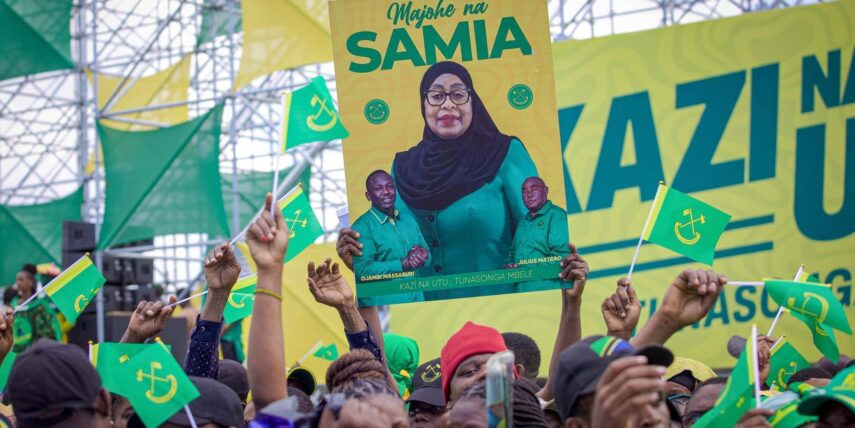
Tanzanians will head to the polls on Wednesday in a general election without the participation of its main opposition parties, leaving President Samia Suluhu Hassan poised for an easy victory in a race criticised by rights groups as one-sided.
In addition to choosing a president, voters will elect members of the 400-seat national parliament and a president and legislators in the semi-autonomous Zanzibar archipelago. Polls open at 0400 GMT and close at 1300 GMT, with results expected within three days, according to the National Electoral Commission.
The main opposition party, CHADEMA, was disqualified in April after refusing to sign an electoral code of conduct. Its leader, Tundu Lissu, is currently on trial for treason, charges he denies. The electoral commission also barred Luhaga Mpina of ACT-Wazalendo, the second-largest opposition party, following an objection from the Attorney General leaving only minor party candidates to challenge Hassan.
Hassan’s ruling Chama Cha Mapinduzi (CCM), whose predecessor led Tanzania’s independence struggle, has dominated the nation’s politics since 1977.
Amnesty International and other rights groups have criticised the election process, accusing the government of repressing dissent claims denied by authorities. The U.S.-based Armed Conflict Location & Event Data Project said CCM is determined to preserve its position as the “last hegemonic liberation party in southern Africa,” resisting the electoral challenges faced by similar ruling parties in South Africa, Namibia, and Zimbabwe.
Hassan, one of only two female heads of state in Africa, rose to power in 2021 after the death of her predecessor, John Magufuli. She was initially praised for easing restrictions on opposition activity and media freedoms, but in recent years, rights campaigners have accused her government of arbitrary arrests and abductions of critics.
Earlier this month, a former Tanzanian ambassador to Cuba, now a vocal government critic, was abducted from his home by unknown assailants, according to his family. Police said they were investigating.
Amnesty International, in an October 20 statement, urged authorities to “end their unacceptable campaign of repression against dissent.” Government spokesperson Gerson Msigwa rejected the allegations, saying the report’s portrayal of Tanzania was “inconsistent with the legal and institutional safeguards in place.”
Hassan, whose campaign posters dominate streets across the country, has promised to build on her infrastructure agenda including expanding roads, railways, and power generation and to prioritise the recruitment of more teachers if re-elected.
