
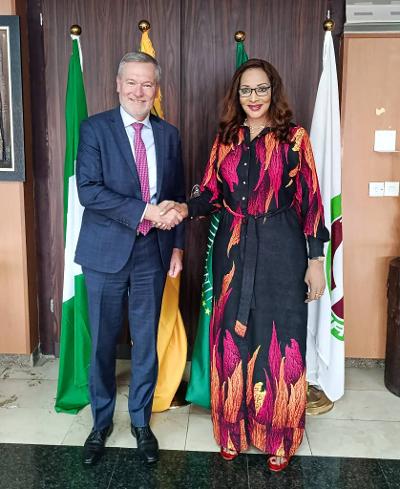
Nigeria and the European Union (EU) have reaffirmed their commitment to strengthening their strategic partnership, with both sides advancing cooperation in security, trade, investment, agriculture, innovation and sustainable development.
The renewed commitment was made during a meeting between the Minister of Foreign Affairs, Ambassador Bianca Odumegwu-Ojukwu, and the European Union Ambassador to Nigeria and ECOWAS, Gautier Mignot, at the Ministry of Foreign Affairs in Abuja.
The meeting reviewed progress in Nigeria-EU relations since the Second Nigeria-EU Ministerial Dialogue held in March 2026 and explored new opportunities for collaboration on bilateral, regional and global issues.
A key highlight of the discussions was the proposed official visit of President Bola Tinubu to Brussels. Ambassador Mignot disclosed that consultations were under way with the Presidents of the European Council and the European Commission, with October 2026 being considered the most likely period for the visit.
“The visit will provide an opportunity to consolidate the Nigeria-EU Strategic Partnership and unveil new areas of cooperation,”Mignot said.
On security, the EU Ambassador announced that the European Union was finalising approval of a €20 million support package under the European Peace Facility to strengthen Nigeria’s counter-terrorism efforts through the provision of counter-drone and counter-improvised explosive device (IED) equipment.
He also revealed plans for an additional €25 million peace and stabilisation programme for Nigeria’s North-West, alongside other initiatives aimed at promoting peace and stability across the country.
Ambassador Mignot further disclosed that negotiations were progressing on the Nigeria-EU Readmission Agreement and the Science, Technology and Innovation Cooperation Agreement, which is expected to expand research opportunities for Nigerian institutions under the Horizon Europe Research Programme.
READ ALSO: Nigeria, EU Deepen Ties on Development, Security, Climate
On economic cooperation, he said preparations were at an advanced stage for a new €25 million agricultural programme focusing on the dairy and cocoa value chains.
He also highlighted growing investments by the European Investment Bank and other European financial institutions in support of small and medium-sized enterprises, particularly women-led and youth-owned businesses, as well as progress under the Nigeria-EU Trade and Investment Dialogue.
In her remarks, Ambassador Odumegwu-Ojukwu welcomed the growing momentum in relations between Nigeria and the European Union and commended the bloc for its continued support through the Global Gateway Initiative, the European Peace Facility and other development programmes.
“The European Union remains one of Nigeria’s foremost trading and development partners,” she said.
She reaffirmed Nigeria’s commitment to deepening cooperation in trade, investment, renewable energy, agriculture, infrastructure, innovation, migration, peace and security.
The Foreign Minister also praised the EU’s sustained support for Nigeria’s security architecture, particularly its assistance to the Multinational Joint Task Force and regional peacebuilding efforts, while welcoming the proposed North-West Stabilisation Programme.
She noted that President Tinubu’s proposed visit to Brussels would further strengthen economic ties, attract greater investment and deepen the existing strategic partnership between Nigeria and the European Union.
The meeting also featured discussions on democratic governance, migration, regional security, developments within ECOWAS and the Alliance of Sahel States (AES), as well as other international issues.
Ambassador Mignot informed the Minister that the European Union intends to deploy an Electoral Expert Mission to Nigeria ahead of the country’s forthcoming elections to provide technical support for electoral reforms and the implementation of previous recommendations.
Both sides also exchanged views on the independence of the International Criminal Court (ICC), freedom of navigation under international law, and the importance of preserving a rules-based international order in addressing emerging global challenges.
