
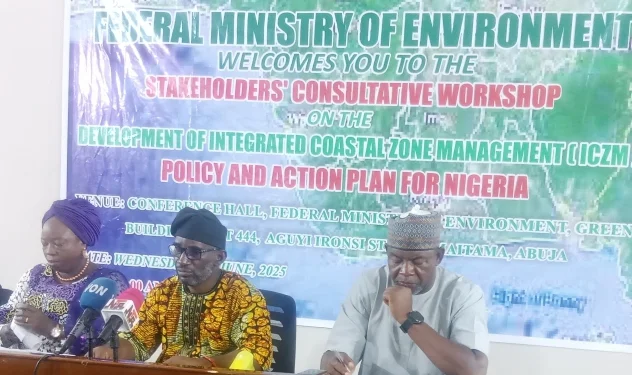
The Nigerian Government has stepped up efforts to safeguard Nigeria’s coastlines with the development of a robust Integrated Coastal Zone Management (ICZM) Policy.
This was disclosed by the Permanent Secretary of the Federal Ministry of Environment, Mr Mahmud Kambari, during a National Stakeholders’ Consultative Workshop on the policy framework, held on Wednesday in Abuja.
Mr Kambari, represented by Mr Kunle Awojemila, Deputy Director of the Department of Flood, Erosion Control and Coastal Management, explained that the ICZM policy is intended to ensure the sustainable use and protection of Nigeria’s coastal and marine resources.
“I express the Ministry’s total commitment to the development of this policy. We are focused on producing a practical framework that will safeguard our coastlines for both current and future needs,” he said.
He emphasised that Nigeria’s coastal zones are not only ecologically significant but also hold major economic value, supporting livelihoods, commerce, and biodiversity.
“Regrettably, these regions are increasingly threatened by climate change, rising sea levels, poor land-use practices, environmental degradation, and frequent natural disasters,” he added.
Also Read: Lagos Signs Strategic Deal with Netherlands on Coastal Erosion
Mr Kambari urged policymakers, academics, private sector stakeholders, and development planners to view the workshop not merely as a forum for dialogue, but as a platform for coordinated action.
“Let us ensure that this policy is grounded in evidence, shaped by inclusive planning, and centred on addressing the needs of the most vulnerable coastal communities,” he stated.
In his contribution, the Director of Erosion, Flood and Coastal Zone Management at the ministry, Mr Usman Bokani—represented by Mr Abdullahi Atta, Assistant Director of Coastal Zone Management—expressed concern about the increasing threats confronting Nigeria’s coastal regions.
He noted that the ICZM policy represents a significant step towards a coordinated and inclusive approach to managing the country’s marine and coastal ecosystems.
“Erosion, flooding, pollution and climate change continue to threaten infrastructure, ecosystems, and public health in these areas,” he said.
Mr Bokani stressed that developing the policy is vital for ensuring the long-term sustainability of Nigeria’s coastline, strengthening economic resilience, and improving living standards in coastal communities.
“With collaboration and informed decision-making, we can establish a more resilient and productive coastal management system,” he concluded.
