
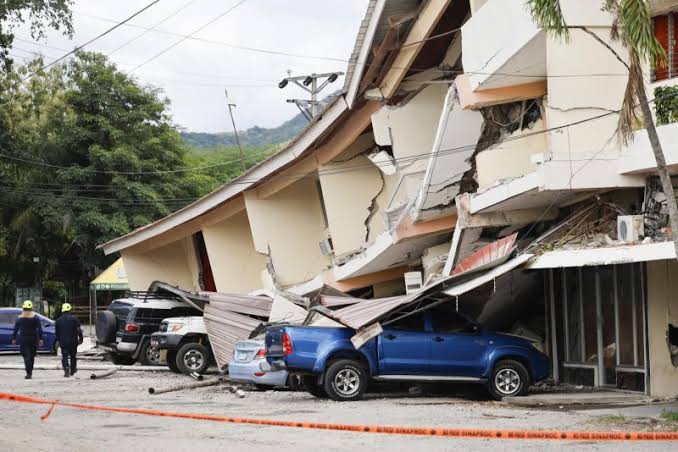
A magnitude 7.7 earthquake struck southern Panama on Friday, damaging buildings and sending thousands of people into the streets, although no deaths or injuries were immediately reported.
The United States Geological Survey (USGS) said the earthquake occurred at a depth of 12.6 kilometres, with its epicentre in a sparsely populated area about 200 kilometres from the capital, Panama City.
More than 40 aftershocks were recorded in the hours following the tremor, but the Panama Canal and Cobre Panama copper mine reported normal operations. Tocumen International Airport also lifted a temporary suspension of flights.
President Raul Mulino visited Penonomé, a city between the epicentre and Panama City, where some buildings collapsed and a church was damaged.
In Panama City, thousands of residents evacuated office buildings and gathered in the streets, causing traffic congestion as workers struggled to find transport home.
Juan Sanchez, a 37-year-old employee of the Economy Ministry, said the evacuation had left many people stranded.
“They evacuated all of these buildings. Everyone is outside. Now the problem is, how do we get home?” he said.
Prolonged Tremors
Nestor Luque, director of Panama’s Geosciences Institute, attributed the earthquake to the Azuero-Soná Fault System, which he said had accumulated substantial pressure that was periodically released.
He said the seismic waves travelled across the country, making the earthquake widely felt.
Luque said he recorded about 40 seconds of shaking in Panama City, although the tremors may have lasted longer in other areas.
Sabina Rios, who was on the sixth floor of an old building dating from the period of US military presence in Panama, described the shaking as unusually strong and prolonged.
“The quake felt strong and lasted a long time, the longest I’ve felt in years,” she said.
Victor Pinzon, a 48-year-old maintenance worker, said he watched window cleaners on a high-rise building sway during the tremors.
“It’s a miracle they didn’t get killed,” he said, adding that they appeared to be “swinging in a hammock”.
Strong earthquakes are uncommon in Panama, and some elderly residents were visibly distressed as they evacuated their homes.
In Herrera province, in southern Panama, 74-year-old Ricardo Brown said his house had developed cracks, raising fears that it could collapse. He also reported seeing several damaged homes in the area.
Omar Smith, head of Panama’s civil protection agency, told Telemetro Reporta that damage had also been reported in Chitré, the capital of Herrera province, and along the coast in Los Santos province.
Infrastructure and Economic Impact
The USGS estimated that about 43,000 Panamanians lived in areas exposed to at least severe shaking. It said potential economic losses could range from one per cent to 10 per cent of the country’s gross domestic product.
Electricity provider Naturgy reported power outages in six provinces.
Despite the damage, the country appeared to have avoided the widespread destruction and casualties recorded in other recent major earthquakes in Latin America.
Back-to-back earthquakes in Venezuela in June killed several thousand people, while a powerful tremor in western Colombia in August killed more than 300.
Panama is scheduled to conduct a nationwide evacuation drill on Monday to test its emergency response arrangements.
