
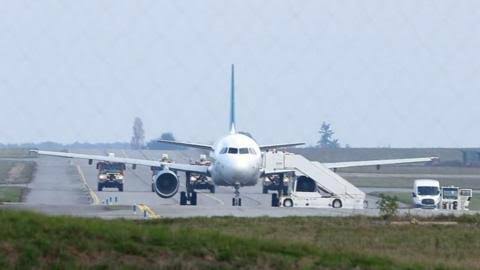
Hoax bomb threats disrupted nearly 30 passenger flights across Europe on Thursday, forcing several aircraft to make emergency landings and prompting fighter jets to escort or intercept others, in an escalation of a wave of threats reported earlier in the week.
The latest incidents followed similar threats on Tuesday, when at least seven flights and a cruise ship were targeted, raising concerns about possible coordinated efforts to disrupt transport and other essential services across the continent.
No government has identified those responsible for the threats, and no claim of responsibility has been verified.
Security experts said the incidents could have been carried out by individuals acting on personal grievances or copycat groups, although they also bore the characteristics of a coordinated hybrid attack.
Eric Schouten, head of aviation security group Dyami, said it was difficult to establish whether a particular country was behind such incidents, but added that the threats were consistent with known methods of hybrid operations.
Several European governments have accused Russia of orchestrating sabotage and other hybrid attacks since its invasion of Ukraine in 2022. Such operations are often relatively cheap to execute, difficult to attribute and unlikely to provoke a direct military response.
Denmark, Poland and Romania, which experienced disruptions on Thursday, have previously accused Moscow of involvement in hybrid attacks. Germany also blamed Russia for an August attack on Leipzig airport.
READ ALSO: Saudi Arabia Extends Riyadh Airport Closure After Houthi Attacks
Britain, which has previously accused Russia of similar activities, linked Iran to a suspected plot against a United States air base. Both Russia and Iran have denied the allegations.
An airport source in Italy told Reuters that an email titled “Threat report” had been sent to several airline, airport operator and service provider addresses at Rome’s Fiumicino and Milan’s Malpensa airports.
The message, purportedly from a group calling itself “fighters of the Male State”, claimed that explosive devices had been placed on incoming flights from Helsinki and Dublin and would detonate within 60 minutes.
Reuters could not independently establish who sent the email or whether the same individuals were responsible for the other threats across Europe.
Vladislav Pozdnyakov, a Russian blogger who founded the anti-feminist Male State movement in 2016 before it was banned in Russia, denied any involvement, saying the group no longer existed.
He said anyone using the group’s name to carry out provocations in European Union countries was acting independently.
Flights diverted and escorted
In France, Prime Minister Sebastien Lecornu’s office said fighter jets had been deployed to intercept an Aer Lingus flight travelling from Dublin to Rome after its pilot failed to respond to authorities as expected.
The aircraft was escorted to an air force base at Evreux. Lecornu’s office did not explain the pilot’s conduct.
Bulgaria’s air force said its fighter jets had escorted three passenger aircraft to the ground. A Ryanair flight from London to Sofia was diverted to Plovdiv, the country’s second-largest city.
Romania’s intelligence agency said a KLM flight travelling to Tel Aviv, with a stopover in Bucharest, had also received a bomb threat.
In Spain, police received three emailed threats within 20 minutes involving two Air Europa flights from Madrid to Paris and four incoming Iberia flights from Rome and Milan. Several aircraft were stopped or returned to their stands in Madrid, while passengers were asked to disembark as security checks were carried out.
In Warsaw, a LOT flight bound for Paris was halted while taxiing for take-off, and passengers were transferred to another aircraft. Danish police also confirmed that two planes had been searched at Copenhagen airport.
Other threatened flights operated by EasyJet, Finnair, LOT, Wizz Air, Ryanair and Air Serbia landed as scheduled, with some receiving military escorts.
A passenger on a Wizz Air flight from Milan, Elena Pala, told Digi TV that the aircraft was directed to a remote part of the runway at Bucharest airport, where it was surrounded by emergency vehicles and anti-terrorism personnel.
Joji Waites, director of flight safety at the British Airline Pilots’ Association, said airlines acted on threats only after security assessors had determined that they were credible.
Wider disruption raises security concerns
Eliran Almog, chief executive of aviation cybersecurity firm Cyviation, said the threats could be intended not only to disrupt operations but also to test how airlines, airports and authorities respond to security incidents.
He noted that the aviation threats coincided with cyberattacks on supermarket refrigeration systems in several European countries.
Unidentified hackers this week disrupted supermarket refrigeration systems for the second time, while several French blood banks were also affected by cyberattacks.
Almog said the incidents targeting different essential services were causing economic disruption and could undermine public confidence.
