
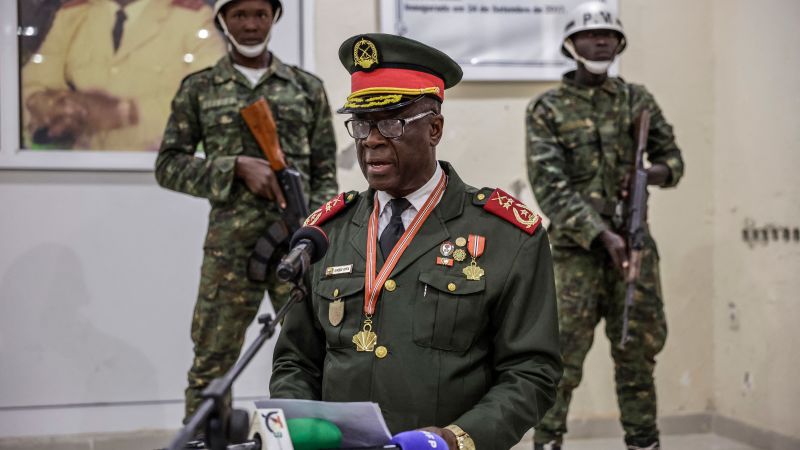
Guinea-Bissau’s military authorities on Thursday installed Major-General Horta Inta-a as transitional president, a day after soldiers seized power in a swift coup that halted the release of results from last weekend’s presidential election.
Ousted President Umaro Sissoco Embaló was flown to Senegal on a special flight following the intervention of the West African regional bloc, Senegal’s foreign ministry said late on Thursday.
The takeover marks the ninth coup in West and Central Africa in five years and extends Guinea-Bissau’s long record of political instability. The country is a key cocaine transit hub and has a history of military interference in governance.
The self-styled High Military Command for the Restoration of Order announced in a televised broadcast on Wednesday that it had removed Embaló, alleging an unspecified destabilisation plot involving politicians and drug traffickers.
Inta-a, dressed in military fatigues and surrounded by senior officers, made his first public appearance at a ceremony aired on state television on Thursday. He claimed the intervention was needed to prevent “narcotraffickers” from “capturing Guinean democracy” and declared a one-year transition period effective immediately. Later that day, he swore in Major-General Tomas Djassi as army chief of staff.
Also Read: Guinea-Bissau Votes as Embalo Seeks Second Term
Gunfire had echoed through parts of the capital, Bissau, for about an hour on Wednesday near the electoral commission and the presidential palace before the coup was announced. Embaló subsequently phoned French media outlets to confirm he had been deposed. An army statement issued early Thursday said he and other officials were “under the control of the High Military Command”.
African Union Chairperson Mahmoud Ali Youssouf condemned the coup and demanded the release of Embaló and all detained officials. Leaders of the regional bloc ECOWAS also denounced the takeover and convened a virtual meeting to assess the situation. Images shared on X showed the presidents of Nigeria, Senegal, Liberia and the AU chair joining the discussions. The European Union urged the restoration of constitutional order and the continuation of the vote count.
In Bissau, soldiers patrolled largely deserted streets on Thursday. Many residents stayed indoors even after an overnight curfew was lifted, while businesses and banks remained shut.
“I’m very concerned about the prevailing situation,” said 30-year-old resident and university lecturer Julio Goncalves. “No pharmacy is open. If somebody is sick, how can he buy medicine or go to the hospital?”
Before Inta-a’s appointment was announced, opposition candidate Fernando Dias accused Embaló of orchestrating a “false coup attempt” to derail the election, claiming he feared losing. A coalition backing Dias demanded that results from Sunday’s vote be released and called for the immediate release of former Prime Minister Domingos Simões Pereira, who was detained on Wednesday.
Security forces fired tear gas to disperse a small protest outside the building where Pereira was reportedly being held and later broke up a gathering near Dias’s residence on the outskirts of Bissau, with witnesses reporting live rounds fired into the air. No casualties were reported.
Guinea-Bissau, a small coastal nation wedged between Senegal and Guinea, is a major trafficking route for South American cocaine destined for Europe. Under Embaló’s administration, analysts say the trade expanded significantly.
“Major traffickers financed electoral campaigns in these elections. There is no sign the impact of cocaine on politics and governance in Bissau will decrease,” said Lucia Bird Ruiz-Benítez de Lugo, director of the Observatory of Illicit Economies in West Africa.
The country has experienced at least nine coups and attempted coups since its independence from Portugal in 1974.
Observers from the African Union and ECOWAS on Wednesday demanded the immediate release of detained election officials. Nigeria’s former President Goodluck Jonathan, who was observing the vote for the West African Elders Forum, could not be reached on Thursday, and his whereabouts were unknown, ECOWAS spokesperson Joel Ahofodji said.
Nigeria’s foreign ministry insisted that the safety of all election observers must be guaranteed and warned that those responsible for the coup “will be held accountable”.
