
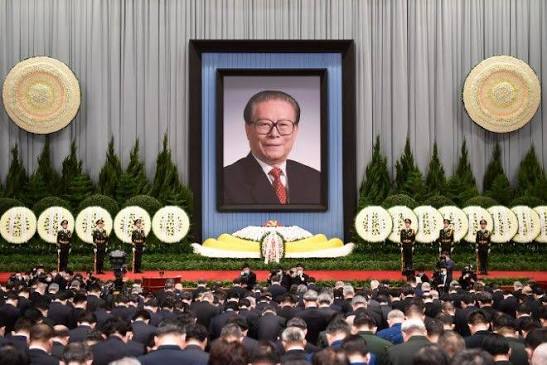
Top Chinese officials, led by President Xi Jinping, gathered at the Great Hall of the People on Monday to commemorate the 100th anniversary of the birth of late leader Jiang Zemin, who led China during a pivotal phase in its rise from a marginal economy to a global growth engine.
Jiang, who died in 2022 at the age of 96, confounded his critics and led the country through a decade of rapid economic growth following the 1989 Tiananmen crackdown on pro-democracy protesters. His key partner in governance, former Premier Zhu Rongji, died last week, with his funeral scheduled for Tuesday.
The passing of the two leaders into China’s history books marks a definitive end to the rapid reforms they represented during the 1990s and early 2000s, with an emphasis on private entrepreneurship and wealth creation.
In a 40-minute speech on Monday, Xi called on the Communist Party to carry forward Jiang’s legacy, presenting the current leadership as a continuation of his political and ideological project.
Under Jiang and Zhu, China implemented major economic reforms, including closing chronically unprofitable state-owned enterprises, replacing the old housing system with a commercial property market, weathering the Asian financial crisis of the late 1990s and joining the World Trade Organisation in 2001.
“On the new journey ahead, we must heighten our sense of vigilance against potential dangers,” Xi said during Monday’s event.
“With an indomitable fighting spirit and superb skill in struggle, we must proactively meet the major tests posed by high winds and rushing waters, or even by raging storms,” he added.
Former Premier Wen Jiabao and former Vice President Wang Qishan, who served as Xi’s anti-corruption chief, were among those seen at the event.
Ahead of Monday’s ceremony, China’s state broadcaster aired a 12-part prime-time documentary series chronicling Jiang’s life and achievements.
READ ALSO: China Rejects New Zealand Espionage Allegations
The programme recounted how, in 1989, Jiang, who had himself been a student protester in the 1940s, ordered the closure of a reformist Shanghai newspaper after it called for greater freedom of speech and voiced support for the pro-democracy demonstrations that culminated in the Tiananmen Square crackdown in Beijing.
During his presidency, the internet arrived in China in the mid-1990s. However, a few years later, the so-called Great Firewall was established to restrict access to information and ideas deemed potentially destabilising to Chinese society.
Still, some Chinese internet users remember Jiang fondly as a symbol of a more optimistic era when rapid economic growth translated into tangible improvements in everyday life.
On Chinese social media, where the names of current and former leaders are routinely censored, Jiang has become known as “the Elder”, inspiring an online subculture that appears to admire the former Soviet-trained automobile factory manager, who was known for his love of singing and his ability to recite Lincoln’s Gettysburg Address from memory in English.
