
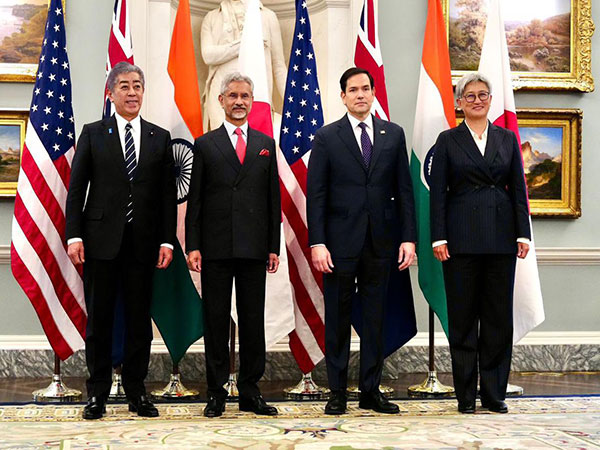
Foreign ministers of the United States, Australia, India and Japan have pledged to strengthen global supply chains and expressed concern over economic coercion and trade practices that threaten international commerce.
The commitment was contained in a joint statement issued on Saturday after a meeting of the four countries, known as the Indo-Pacific Quad, amid growing concerns over restrictions on critical mineral exports and China’s dominance of the rare earths market.
The meeting came as Japan stepped up criticism of Beijing over its restrictions on critical mineral exports, while the United States worked to build a coalition of G20 countries concerned about China’s influence in the sector.
The discussions took place shortly before US Secretary of State Marco Rubio hosted the final session of a meeting of G20 foreign ministers in Atlanta, which also included China.
In their joint statement, the Quad ministers reaffirmed their commitment to a free and open Indo-Pacific, stressing that economic security was essential to global stability and prosperity.
They expressed grave concerns about what they described as economic coercion, including arbitrary export restrictions and non-market policies that create excess production capacity and disrupt supply chains in critical industries.
READ ALSO: Iran, United States to Hold Nuclear Talks Friday
The ministers also underscored the importance of protecting freedom of navigation and navigational rights in the Strait of Hormuz, the Red Sea and the Bab el-Mandeb Strait.
As part of efforts to strengthen regional economic security, the four countries pledged more than $85 million in assistance to support trusted artificial intelligence technologies across the Indo-Pacific.
They also announced plans for a new initiative to identify weaknesses in semiconductor and related supply chains before they cause disruptions.
The meeting marked the third gathering of Quad foreign ministers this year, as preparations continued for US President Donald Trump to attend his first formal summit with the leaders of the four countries next month in Manila, during a conference of the Association of Southeast Asian Nations.
Rubio told reporters that an announcement on the proposed leaders’ meeting in Manila would hopefully be made soon, although he provided no further details.
He maintained that the Quad was not an anti-China or anti-anybody coalition, but said the joint statement addressed practices and activities that repeatedly originated from one country.
Rubio added that Washington had invested considerable effort in the partnership and intended to expand cooperation through specific projects and initiatives.
Among them is a $20 million project in Palau aimed at improving the country’s digital infrastructure.
He also said the four countries had made significant progress in coordinating resources to respond to humanitarian emergencies and natural disasters.
The Quad members are also planning to establish a business forum to create opportunities for companies from the four countries to strengthen commercial cooperation.
