
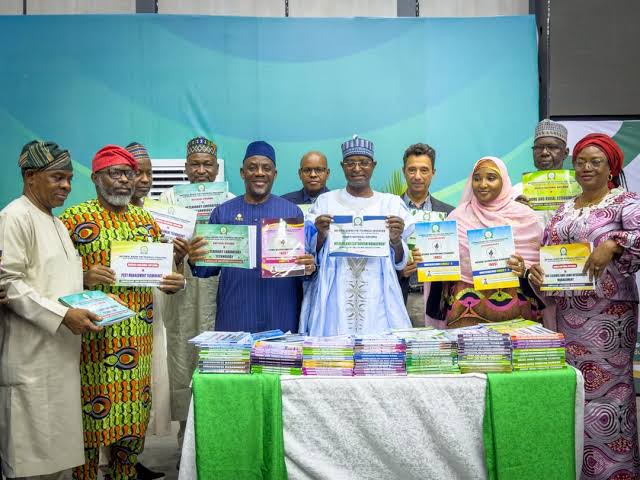
The Nigerian Government has introduced 39 reviewed and newly developed agricultural curricula and 31 National Occupational Standards (NOS), alongside an 80:20 practical-to-theoretical training model, to boost food security, create jobs for young people and improve agricultural productivity.
The Minister of Education, Dr Maruf Tunji Alausa, unveiled the reforms at the UBEC Digital Resource Centre in Abuja, describing them as part of efforts to align education with industry needs and equip learners with practical skills for economic growth.
Alausa said the initiative was designed to develop a skilled workforce capable of applying modern agricultural technologies, increasing production and establishing sustainable agribusinesses.
He explained that the reform process began in 2025 through collaboration among the Federal Ministries of Education, Agriculture and Food Security, and Livestock Development, as well as regulatory agencies, educational institutions, curriculum experts and industry stakeholders.
According to the minister, the exercise produced 39 curricula, comprising 32 reviewed programmes and seven newly developed ones, alongside 31 National Occupational Standards covering National Diploma (ND), Higher National Diploma (HND) and relevant Nigeria Certificate in Education (NCE) agricultural programmes.
He said the NCE component was developed in collaboration with the National Commission for Colleges of Education (NCCE).
READ ALSO: FG Pledges to Stabilise Agricultural Equipment Prices Nationwide
Alausa identified the 80:20 practical-to-theoretical training ratio as a major feature of the reform, explaining that it would prioritise hands-on learning through teaching farms, greenhouses, processing facilities and agricultural technology hubs.
The revised curricula also cover emerging areas such as precision agriculture, climate-smart agriculture, artificial insemination and agribusiness to prepare graduates for changing industry requirements and encourage entrepreneurship.
The minister pledged to work with relevant ministries, regulatory bodies, educational institutions and industry partners to ensure effective implementation.
He said the success of the reforms would be assessed through graduates’ practical competence, increased agricultural output, job creation and measurable improvements in national food security.
The Minister of Livestock Development, Alhaji Idi Mukhtar Maiha, commended the initiative, describing it as an important step towards practical, industry-oriented agricultural education.
Maiha praised President Bola Tinubu’s emphasis on agriculture and livestock development and acknowledged the contributions of the education and agriculture ministries and the technical team involved in the exercise.
He said livestock remained vital to food and nutrition security, employment, industrial development and exports.
Citing the Middle East red meat market, estimated at $3.2 billion, Maiha said Nigeria’s ability to compete in the sector was limited by inadequate organisation and a shortage of practical expertise.
He urged educational institutions to establish functional farms, adopt digital and climate-smart agricultural practices, and expand access to skills, technology, finance and markets.
The minister also called for practical training facilities to be made central to institutional accreditation.
The Minister of State for Education, Prof. Suwaiba Sa’id Ahmad, described the initiative as a major milestone in repositioning Technical and Vocational Education and Training (TVET), improving teacher preparation and aligning education with labour-market needs.
She said competency-based teaching and clearly defined occupational standards would improve training quality and prepare graduates for productive employment.
Ahmad urged regulatory agencies, institutions and industry partners to support implementation by providing qualified instructors, adequate equipment, functional workshops and continuous professional development.
She also called for stronger partnerships with industry to expand apprenticeships, industrial attachments and workplace learning, while ensuring equal opportunities for women, persons with disabilities and young people from underserved communities.
