
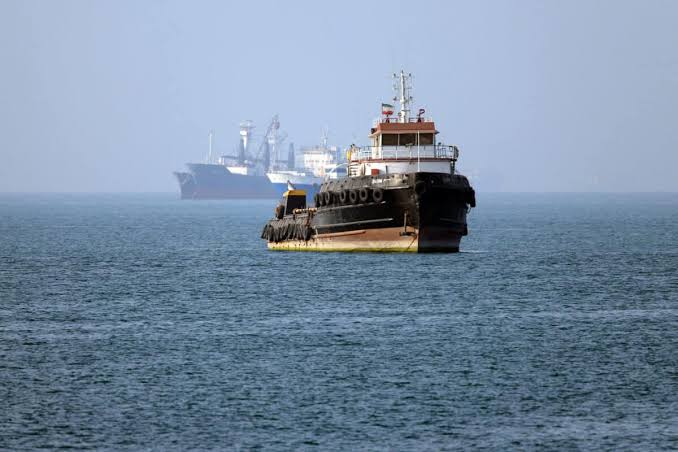
Iran and Oman have agreed on designated safe shipping routes through the Strait of Hormuz as attacks and restrictions continue to disrupt traffic through the strategic waterway.
Iranian Foreign Ministry spokesman Esmaeil Baghaei said on October 7 that the two countries had agreed on the geographical coordinates of the routes and procedures for communicating the information to relevant international maritime authorities, according to state news agency IRNA.
The agreement does not amount to a full reopening of the Strait of Hormuz, with Iranian officials warning that unauthorised routes could still be closed.
Mohammadreza Naqdi, an adviser to Iran’s Revolutionary Guards, said Iran would shut routes it considers unauthorised, particularly passages along Oman’s coast that Tehran believes are being used to circumvent its restrictions.
Shipping traffic through the Strait remains significantly below normal levels. Kpler data cited by Reuters showed that only seven commodity vessels crossed the waterway on October 6, the lowest daily figure since July 23.
LSEG data, which uses a broader vessel-tracking methodology, recorded eight crossings on the same day.
Crude oil flows through the Strait also fell by 27 per cent from the previous week’s wartime high to about 10.1 million barrels per day, representing roughly 74 per cent of pre-war levels, according to Kpler analysts.
READ ALSO: Iran Sets Conditions for Strait of Hormuz Reopening
Most of the decline was attributed to reduced ship-to-ship transfers in the Gulf of Oman.
Some crude volumes have been redirected through alternative routes. Crude exports along the Gulf of Oman coast and through the Red Sea rose to about 6.7 million barrels per day, more than twice pre-war levels, helping keep overall Middle Eastern crude exports close to pre-conflict levels.
Security concerns, however, remain high.
At least 12 attacks, attempted attacks or harassment incidents involving oil, liquefied natural gas (LNG) and liquefied petroleum gas (LPG) tankers were recorded between September 28 and October 2, according to a maritime security source cited by Reuters.
The risks were underscored on October 7 when a tanker was struck by multiple projectiles about 94 kilometres north of Qatar’s Madinat ash Shamal, according to the United Kingdom Maritime Trade Operations agency. Casualties were reported.
The renewed shipping concerns also pushed oil prices higher.
Brent crude rose nearly four per cent to $104.18 a barrel on October 8, while US West Texas Intermediate (WTI) gained 3.9 per cent to $91.70 a barrel, according to the Associated Press.
The Iran-Oman agreement therefore represents an attempt to establish a controlled shipping corridor rather than a full reopening of the Strait.
The effectiveness of the designated routes will depend on whether tankers can use them consistently and safely amid continuing security risks and restrictions.
