
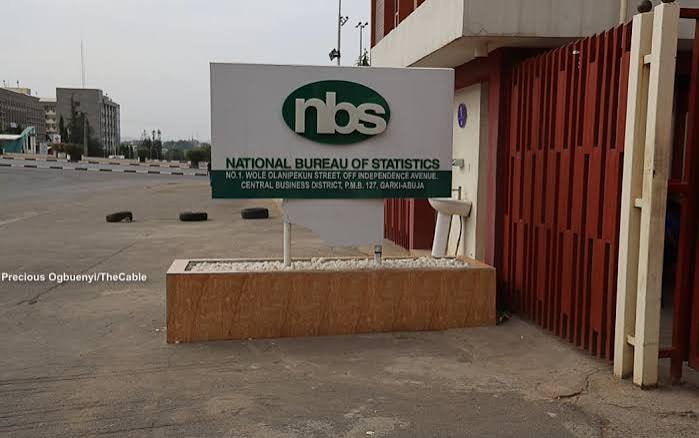
Nigeria’s merchandise trade surplus climbed to N12.60 trillion in the second quarter of 2026, more than doubling from the corresponding period of 2025, driven by higher exports and a decline in imports.
The National Bureau of Statistics (NBS), in its Foreign Trade in Goods Statistics Report for Q2 2026, put the country’s trade balance at N12,596.86 billion, representing a 101.32 per cent increase from the same quarter of 2025.
The report said total merchandise trade stood at N41.44 trillion during the quarter, up 5.61 per cent from N39.24 trillion recorded in Q2 2025 and 19.13 per cent higher than the N34.79 trillion recorded in Q1 2026.
Exports rose to N27.02 trillion, an 18.77 per cent increase from N22.75 trillion recorded in Q2 2025. The figure was also 27.64 per cent higher than the N21.17 trillion recorded in the first quarter of 2026.
Exports accounted for 65.20 per cent of Nigeria’s total merchandise trade during the period.
READ ALSO: Nigeria’s Economic Team Unveils Livestock Growth Strategy
Crude oil remained the largest single export, with a value of N12.91 trillion, representing 47.79 per cent of total exports.
However, non-crude exports collectively generated N14.11 trillion, accounting for 52.21 per cent of total exports. Non-oil products contributed N3.73 trillion, or 13.80 per cent.
Crude oil exports increased by 7.93 per cent from N11.97 trillion in Q2 2025 and by 15.28 per cent from N11.20 trillion recorded in Q1 2026.
Other oil products also recorded substantial growth, reaching N10.38 trillion, up 34.08 per cent year-on-year and 53.05 per cent from the preceding quarter.
Imports fall year-on-year
Total imports declined to N14.42 trillion in Q2 2026, down 12.55 per cent from N16.49 trillion recorded in Q2 2025.
On a quarterly basis, however, imports increased by 5.91 per cent from N13.62 trillion in Q1 2026. Imports accounted for 34.80 per cent of total merchandise trade.
China remained Nigeria’s biggest source of imports, supplying goods worth N5.92 trillion, equivalent to 41.02 per cent of total imports.
The United States followed with N1.01 trillion, representing 6.97 per cent, while India accounted for N924.46 billion, or 6.41 per cent. The Netherlands supplied N409.81 billion, representing 2.84 per cent, while Germany accounted for N395.87 billion, or 2.74 per cent.
Machinery and transport equipment constituted the largest import category at N5.46 trillion, followed by chemicals and related products at N2.51 trillion and manufactured goods at N1.87 trillion.
India was Nigeria’s leading export destination during the quarter, receiving goods worth N3.29 trillion, equivalent to 12.17 per cent of total exports.
Spain followed with N1.98 trillion, the Netherlands with N1.90 trillion, the United States with N1.73 trillion and Togo with N1.50 trillion.
Together, the five countries accounted for 38.51 per cent of Nigeria’s exports during the quarter.
Nigeria records stronger African trade
Nigeria’s exports to other African countries stood at N6.65 trillion, while imports from the continent totalled N1.10 trillion.
Togo was Nigeria’s largest African export market, receiving goods valued at N1.50 trillion. It was followed by South Africa at N1.34 trillion, Côte d’Ivoire at N1.22 trillion, Ghana at N461.36 billion and Egypt at N455.81 billion.
The five countries jointly accounted for 74.75 per cent of Nigeria’s exports to Africa.
Within West Africa, Nigeria exported goods worth N3.82 trillion and imported goods valued at N280.66 billion.
Togo and Côte d’Ivoire were the leading export destinations in the sub-region, followed by Ghana, Senegal and Benin.
Agricultural exports decline
Despite the overall rise in exports, agricultural exports recorded a significant decline during the quarter.
Their value fell to N802.99 billion, representing a 36.09 per cent decrease from N1.26 trillion in Q2 2025 and a 31.51 per cent drop from N1.17 trillion in Q1 2026.
Cashew nuts in shell remained the leading agricultural export at N268.62 billion, followed by standard-quality cocoa beans valued at N154.31 billion and sesame seeds at N96.03 billion.
Agricultural imports moved in the opposite direction, rising to N1.20 trillion, an increase of 1.63 per cent year-on-year and 45.43 per cent from the previous quarter.
Solid mineral, raw material exports rise
The NBS also reported strong growth in exports of solid minerals and raw materials.
Solid mineral exports rose to N146.91 billion, representing a 90.03 per cent increase from Q2 2025 and a 42.91 per cent rise from Q1 2026.
Raw material exports recorded an even sharper increase, reaching N2.31 trillion. This represented growth of 181.24 per cent from N819.72 billion in Q2 2025 and 50.31 per cent from N1.53 trillion in Q1 2026.
According to the NBS, urea was the leading raw material export, valued at N1.07 trillion and shipped to the United States.
Non-monetary gold in powder form exported to Switzerland was valued at N73.09 billion.
Maritime transport dominates trade
Maritime transport continued to account for the bulk of Nigeria’s international merchandise trade.
Exports transported by sea were valued at N26.75 trillion, representing 98.99 per cent of total exports. Sea transport also handled imports worth N13.66 trillion, accounting for 94.74 per cent of total imports.
Apapa Port handled the largest share of exports, valued at N19.07 trillion, representing 70.57 per cent of total exports.
Lekki Deep Sea Port followed with N5.03 trillion, or 18.62 per cent.
For imports, Apapa Port also recorded the highest value at N6.46 trillion, followed by Tin Can Island Port with N2.17 trillion and Lekki Deep Sea Port with N1.61 trillion.
