
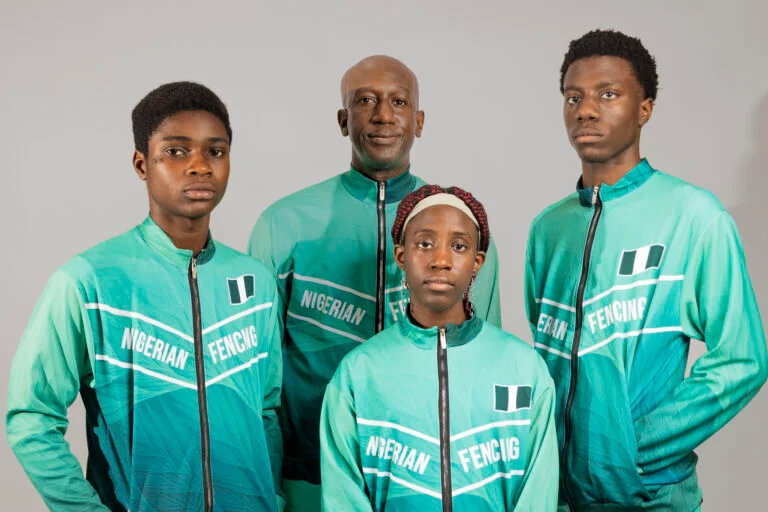
The Nigeria Fencing Federation has unveiled a 12-member squad for the 23rd African Fencing Championships, scheduled to take place at Charterhouse, Lagos, from 25 to 29 June.
This will be the third time the continental tournament is being hosted in Sub-Saharan Africa, following previous editions in Senegal (2002) and Mali (2009 and 2019).
According to the Federation, leading Team Nigeria is U.S.-based fencer Inkosi Brou, who holds the distinction of being the country’s first international fencing medallist. The 17-year-old recently claimed bronze at the 2025 African Junior Championships in Angola and has competed in several international events as part of his campaign to qualify for the Los Angeles 2028 Olympics.
Brou, a grandson of the late NAFDAC Director-General, Professor Dora Akunyili, brings valuable experience and leadership to the youthful squad.
Also included in the team are UK-based Oluwafolayemi Akinyosoye and homegrown fencers such as Wisdom Okanlawon and brothers Mahatir and Mahadi Idongesit. Other male team members are Olumuyiwa Ige, Oritsematosan Egbesemirone, Alex Chizim Aninyei, and Babade Adegbola.
The women’s squad features Peluola Akinbamiro, Somto Eribenne, Sara Idongesit, and Adebodunrin Thomas.
Team Nigeria will compete in both individual and team categories across all three fencing disciplines: foil, epee, and sabre.
Also Read: Cricket: Nigeria Set for 11th Kwibuka T20 Women’s Tournament in Kigali
National coach, Ibrahim Alogba, expressed optimism about the team’s chances:
“Our team is young in age and experience, which lowers pressure. We may surprise stronger teams,” he said.
“We are not afraid of reputations or records. This generation is ready to end Nigeria’s medal drought.”
Italian coach Riccardo Bardin, who joined the squad a week ago, commended the athletes’ commitment but emphasised the importance of patience and long-term development.
Countries set to compete alongside Nigeria include Tunisia, Egypt, Morocco, Kenya, Benin Republic, Côte d’Ivoire, Algeria, Senegal, Mauritius, Angola, Rwanda, Niger, South Africa, Guinea, Libya, Burkina Faso, and Cape Verde.
The championship will feature 12 events in total six individual and six team contests across the three disciplines.
