
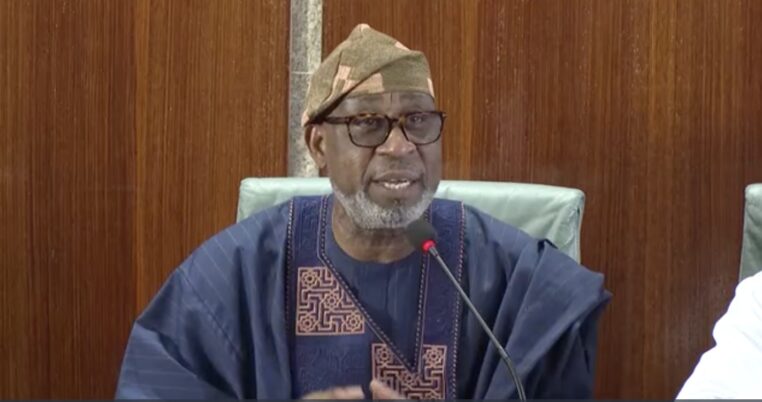
Dr. Dele Alake, Nigeria’s Minister of Solid Minerals Development, has been re-elected as Chairman of the Africa Minerals Strategy Group (AMSG), a continental forum of African ministers tasked with overseeing minerals and mining. The group is committed to coordinated strategies aimed at increasing value addition and beneficiation from Africa’s abundant mineral resources.
Dr. Alake first assumed the role as the group’s pioneer Chairman in 2024 during the Future Minerals Forum (FMF). He secured a second term at the 2026 Annual General Meeting (AGM), held on the sidelines of the same conference in Riyadh, Saudi Arabia.
To strengthen its governance framework, the AMSG approved the creation of new leadership positions, including Vice-Chairman, Deputy Secretary-General, and Financial Secretary. These roles will be distributed across Africa’s sub-regions to ensure inclusion and regional balance.
While the Chairman and Vice-Chairman positions are reserved for serving ministers and elected, other roles are appointed by member states based on zoning arrangements.
Under the updated structure, Dr. Alake continues as Chairman representing West Africa. Hon. Louis Watum Kabamba, Minister of Mines of the Democratic Republic of Congo, was elected Vice-Chairman for Central Africa. The Secretary-General role remains with Uganda (East Africa), Mauritania was appointed Deputy Secretary-General (North Africa), and South Africa assumes the Financial Secretary position.
The AGM also approved a two-year tenure for the new executive committee and confirmed that zoned positions are attached to member countries, ensuring that successors automatically inherit the role when ministers are replaced.
In his acceptance remarks, Dr. Alake thanked his colleagues for their confidence and highlighted the need for African nations to collaborate in harnessing the continent’s economic potential through mineral development. He urged member states to establish minimum financial contributions and refine the group’s budget framework to enhance operational effectiveness.
“Once member states contribute, accountability will naturally follow. This will enhance transparency and strengthen the credibility of the AMSG before the global community,” Dr. Alake stated.
The AGM also resolved to hold quarterly ministerial meetings and ratified the creation of standing committees, including Legal, Institutional Affairs & Human Resources; Sustainability and Responsible Mining; and Finance, Budget & Resource Mobilisation. Plans were also discussed to host a global minerals conference in Africa, modelled after the FMF.
Also Read: Minister of Solid Minerals Welcomes Conviction of Ansaru Commander
During a Leadership Roundtable titled “Africa: Unlocking Infrastructure Funding for Copper-Belt Production”, held alongside the FMF and attended by ministers, development partners, and private-sector stakeholders, Dr. Alake emphasised that mineral production alone cannot drive sustainable economic transformation without robust infrastructure, harmonised policies, and deliberate value-addition strategies.
He cited the Lobito Corridor as an example of successful synergy between rail, ports, energy systems, and policy alignment. Dr. Alake also identified similar opportunities across the continent, including the Lagos–Abidjan Corridor linking Nigeria, Benin, Togo, Ghana, and Côte d’Ivoire; the Walvis Bay Corridor in Southern Africa; and the Dar es Salaam and Central Corridors in East and Central Africa.
“The real question is not whether Africa has corridors, but whether these corridors are being financed, governed, and structured to support industrial growth, regional integration, and long-term stability. What matters is how financing is designed to reduce risk, attract private capital, and sustain commercial viability while advancing national and regional development objectives,” Dr. Alake explained.
He stressed that unlocking large-scale investment requires addressing bankable offtake arrangements, harmonised cross-border regulations, coordinated rail, port, and power planning, and clear pathways for processing, smelting, logistics, and industrial clusters along these corridors.
Dr. Alake concluded that the AMSG’s broader vision is to ensure Africa’s mineral infrastructure is strategically planned, responsibly financed, and efficiently managed—not to discourage investment, but to align it with long-term stability, transparency, and shared economic prosperity.
