
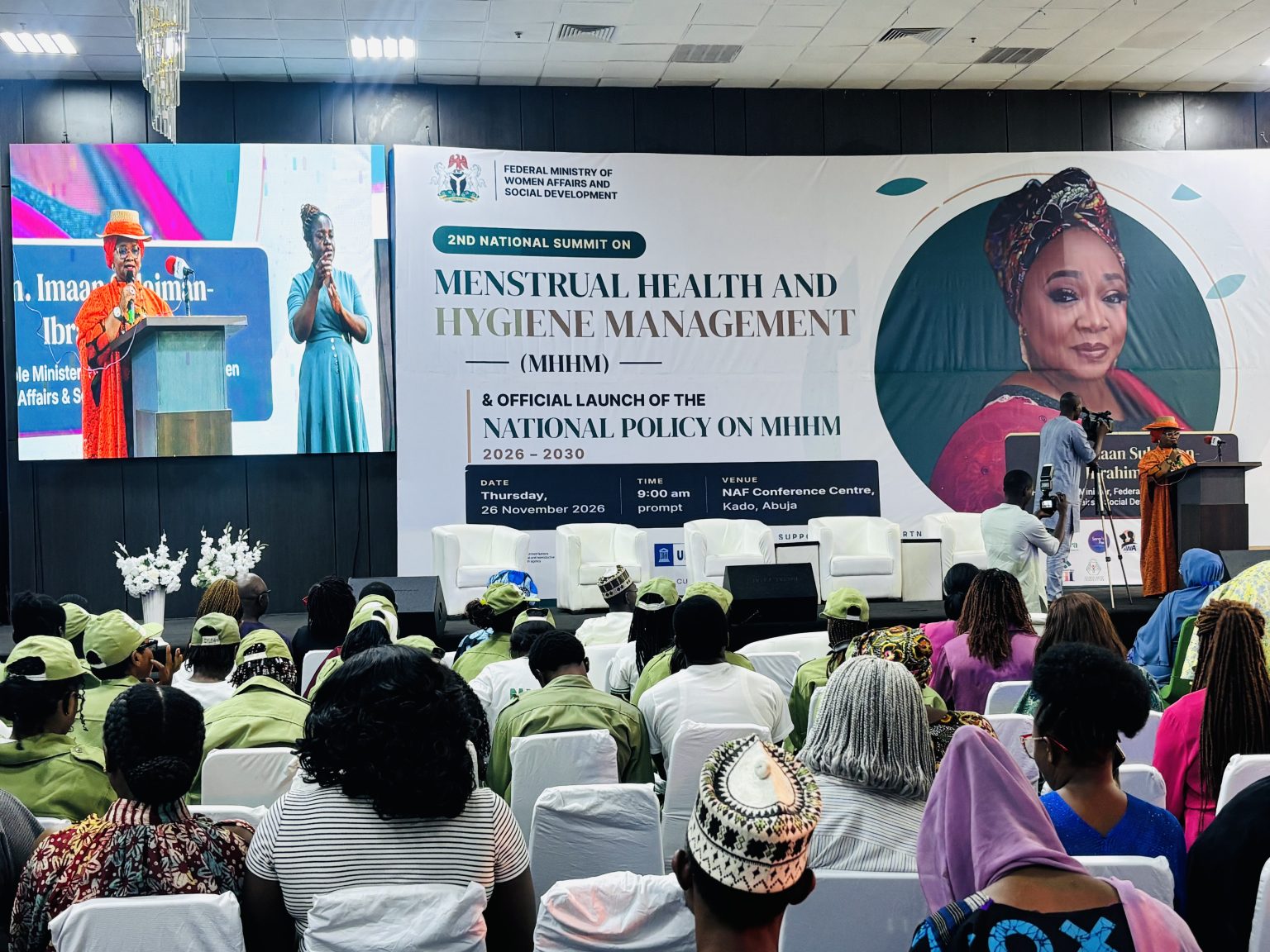
The Nigerian government has launched the National Policy on Menstrual Health and Hygiene Management 2026–2030 , with government and development partners calling for its adoption, adequate funding and effective implementation to ensure tangible improvements in the lives of women and girls.
The National Policy was approved by the Federal Executive Council on October 28, 2026, following consultations and validation involving stakeholders across the six geopolitical zones and was unveiled at the 2nd National Summit on Menstrual Health and Hygiene Management 2026 in Abuja.
The Minister of Women Affairs and Social Development, Hajiya Imaan Sulaiman-Ibrahim, represented by the Chairman of the Governing Council of the Maryam Babangida National Centre for Women Development, Princess Jumai Idonije, called on state governments to adopt and domesticate the policy and provide dedicated budgetary allocations for its implementation.
She also urged the 774 Local Government Authorities to channel resources directly to public schools, primary healthcare centres and displacement settlements to ensure access to affordable menstrual products, clean water and hygienic sanitation facilities.
READ ALSO: FG Intensifies Efforts to End Child Marriage
The Minister stressed the need to move beyond policy approval to funded implementation and measurable impact, noting that the success of the policy would help women and girls, particularly those in rural, underserved and conflict-affected communities.
She also announced plans by the Ministry to institute an Annual National Menstrual Dignity and Hygiene Excellence Competition and Awards to recognise states, local governments, development partners, traditional and religious institutions, community champions and corporate organisations demonstrating commitment to menstrual health.
In her remarks, the Country Director of WaterAid Nigeria, Evelyn Mere, identified government leadership, partnership, institutional commitment and broad stakeholder consultation as critical to the successful development and implementation of the policy.
Represented by the Head of Strategy, Programme Effectiveness and Learning at WaterAid Nigeria, Abdulmalik Abubakar, she called for a costed implementation strategy with clear targets and timelines, as well as continuous monitoring to ensure that the policy delivers tangible results for women and girls across the country.
She commended the Federal Ministry of Women Affairs and Social Development for providing the institutional leadership towards the development of the National Policy on Menstrual Health and Hygiene Management, while acknowledging the contributions of development partners, civil society organisations, academia, the private sector and the National Technical Working Group.
She stressed that policy approval was only the beginning, noting that its success would depend on effective implementation, adequate funding and budgetary allocations to ensure access to affordable menstrual products, safe sanitation facilities, accurate information and quality menstrual health services, while addressing stigma and discrimination.
The representative of Population Services International, PSI, Plangnan Dishil, identified dedicated financing, state adoption and effective accountability mechanisms as key priorities for translating the policy into action.
She stressed the need to ensure that its provisions result in affordable menstrual products, safe sanitation facilities and improved access to menstrual health information at state and community levels.
The representative of the Nigerian Supreme Council for Islamic Affairs, Nike Abdulrahman, has described the National Policy on Menstrual Health and Hygiene Management as more than a policy, but a promise to every Nigerian girl.
She said Islam does not regard menstruation as a source of shame but as a natural condition ordained by Allah, noting that the religion teaches compassion and kindness towards women. She also called for greater attention to endometriosis and other menstrual-related conditions affecting women.
Abdulrahman pledged the Council’s support in promoting menstrual dignity through mosques and Islamic schools across the country, using the platforms to raise awareness and encourage parents and husbands to support their daughters and wives during menstruation.
