
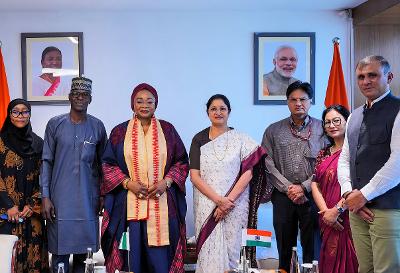
Nigeria’s Minister of Women Affairs and Social Development, Hajiya Imaan Sulaiman-Ibrahim, and India’s Minister of Women and Child Development, Smt. Annpurna Devi, have discussed ways to strengthen cooperation in women’s economic empowerment, child nutrition, early childhood development, women’s safety and gender-responsive budgeting.
The meeting, held on the sidelines of the BRICS Summit in New Delhi, focused on adapting successful Indian policies and programmes to Nigeria’s development needs.
The two ministers explored opportunities for policy exchange, institutional strengthening and joint programmes that could deliver measurable benefits to women and children.
A key area of interest is India’s self-help group, affinity group and collective models for women’s economic empowerment, which have received support through successive World Bank programmes.
Nigeria expressed interest in the approach, particularly its systems for grants and financing, skills development, entrepreneurship, market access, collective bargaining and increased participation of women in local economic activities.
Women’s participation in manufacturing was also identified as a potential area of partnership. India shared labour policies aimed at creating more supportive workplaces, including provisions requiring establishments with more than 50 women workers to provide crèche facilities.
On women’s safety, India presented its network of safe homes operated by State Governments and NGOs under Ministry oversight. The facilities offer temporary accommodation, psychosocial support, counselling, legal assistance and links to government services, complemented by the 181 universal women’s helpline.
Nigeria could adapt elements of the model to establish more accessible and coordinated support services for women in crisis.
READ ALSO: Nigeria, China Sign Landmark Deals to Empower 10 Million Women
The ministers also discussed early childhood development and childcare, with Nigeria showing interest in India’s Anganwadi system. The programme combines early childhood education, healthcare, nutrition and maternal support for children up to six years and pregnant women.
Nutrition and malnutrition management were another priority, particularly India’s systems for identifying, registering, treating and monitoring malnourished children through integrated health and nutrition services.
The meeting further considered maternal health, including India’s maternity cash benefit programme, which provides financial assistance to eligible mothers while encouraging the use of formal healthcare and facility-based delivery.
India’s experience with gender-responsive budgeting was also identified as a potential area for learning. Its framework allocates about 9.7 per cent of the annual budget to programmes benefiting women and girls, covering areas such as safety, social protection and economic empowerment.
On women’s leadership and political participation, the discussions examined India’s reserved representation for women at grassroots government level and broader measures to increase female participation in legislative and decision-making institutions.
The ministers also highlighted positive masculinity as an important component of gender equality, particularly in engaging men and boys on women’s economic participation, childcare, safety and the prevention of gender-based violence.
Other areas under consideration include gender legislation, institutional development, grants and financing, manufacturing, adoption and child protection, as well as technical capacity-building between relevant institutions.
As a next step, Nigeria and India proposed developing a structured cooperation framework on women and child development, beginning with technical exchanges, institutional partnerships and study visits.
Initial areas of engagement would include nutrition, women’s collectives, women’s safety and safe homes, early childhood development, gender-responsive budgeting and women’s economic empowerment.
The proposed partnership would enable Nigeria to study and adapt relevant Indian approaches to its own context while creating opportunities for cooperation in skills development, manufacturing, investment and women-led economic activities.
