
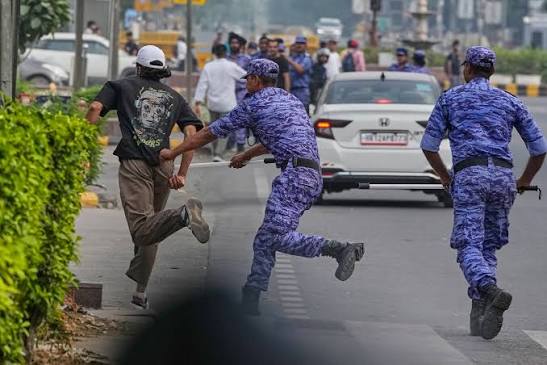
Authorities in India’s capital, New Delhi, closed six metro stations and imposed traffic restrictions on Monday as opposition parties prepared to march to the Supreme Court to protest a controversial revision of voter lists.
The protests have intensified calls for the resignation of Chief Election Commissioner Gyanesh Kumar over the exercise, which critics allege favours Prime Minister Narendra Modi’s Bharatiya Janata Party (BJP).
Opposition parties and supporters of the Cockroach Janta Party (CJP) youth movement have staged near-daily demonstrations this month, demanding accountability over the voter registration exercise.
The revision, which began last year, has resulted in the deletion of more than 130 million names from electoral rolls, including those of deceased persons, people who relocated and individuals who could not be traced.
Police detained thousands of protesters in Delhi over the weekend, including CJP leaders, as security personnel prevented demonstrators from marching through central parts of the city.
On Monday, authorities closed six metro stations on security grounds and imposed traffic restrictions and diversions along more than 20 routes.
The main opposition Congress party announced plans to march to the Supreme Court to submit a memorandum to the Chief Justice, demanding an end to what it described as “vote theft” and calling for Kumar’s resignation.
Congress leader Rahul Gandhi said the march would bring together young people, opposition parties and civil society groups committed to democracy and the Indian Constitution.
However, Chief Justice Surya Kant declined a request to meet Gandhi and a Congress delegation, advising them to pursue the matter through legal proceedings because the issue was already before the court, according to a Congress source.
READ ALSO: Indian Police Detain 2,000 Protesters in Election Dispute
Separately, the CJP said its leaders would meet Delhi Police to demand a date for a peaceful demonstration. The movement threatened to announce another protest if the authorities failed to provide a date within 24 hours.
The controversy intensified after the Indian Express newspaper reported last month that two deputy election commissioners had raised concerns internally about voter list revisions, registration procedures and digital systems.
Election Commission data showed that approximately 130 million names had been removed during the verification exercise. These included about 28 million deceased persons, 63 million people who had relocated and 30 million individuals who could not be traced.
Opposition parties allege that Muslim voters and other minorities are disproportionately affected by the deletions because they are less likely to support the ruling BJP. Both the Election Commission and the BJP have rejected allegations of political bias.
The Election Commission maintains that voters whose names were wrongly deleted can re-register, while the BJP has accused opposition parties of undermining democracy by questioning legitimate electoral procedures.
The CJP youth movement has organised demonstrations in recent months over issues including government school infrastructure and employment, emerging as a significant challenge to Modi and his party, which has been in power for 12 years.
