
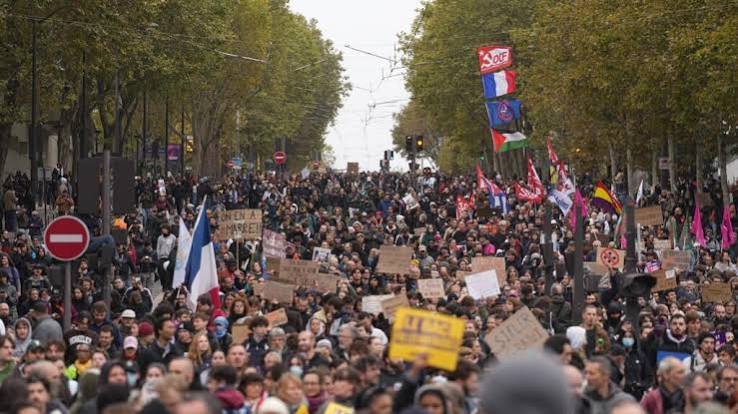
Scuffles have erupted in Paris and other French cities following nationwide demonstrations over rising living costs and strained public services, as authorities warned of possible further violence during Halloween celebrations.
The protests, which remained largely peaceful throughout Saturday afternoon, entered their third consecutive weekend amid growing public discontent with President Emmanuel Macron’s government and concerns over the country’s economic difficulties.
Riot police moved to disperse groups of demonstrators at the end of a march in Paris, while tear gas was deployed in Lyon, France’s third-largest city, and Toulouse in the south-west.
Tensions also emerged during unauthorised demonstrations in Marseille, although calm had returned by nightfall.
Interior Minister Laurent Nunez said security forces had maintained control of city centres despite facing considerable violence.
He warned that authorities were preparing for further disturbances, citing calls for unrest during Halloween celebrations.
“The day is not over. We are ready for those looking for a fight tonight, and we will respond firmly,” Nunez said.
The demonstrations brought together students, trade unions and members of the Yellow Vest movement, who have been protesting against rising living costs, high fuel prices, inflation and deteriorating public services.
The protests, which began with student mobilisation in September, have also inspired youth-led demonstrations in Germany and Italy.
One of the protesters, Jerome Rodriguez, criticised the government’s handling of the economy, saying ordinary families were struggling while the authorities continued to manage large financial resources.
He said demonstrators would continue pressing their demands despite what he described as limited prospects of receiving a response from the government.
Far-left leader Jean-Luc Melenchon, whose popularity has increased ahead of next April’s presidential election, led the Paris demonstration.
The number of participants was lower than in the previous two weekends, with the Interior Ministry estimating that 320,000 people took part nationwide, including 70,000 in Paris.
This compared with 410,000 protesters the previous weekend and 550,000 on October 17.
The ministry said security forces had prevented radical groups from breaking away from demonstrations to engage in vandalism and looting in cities including Bordeaux, Toulouse, Lyon and Marseille.
It added that security checks at railway stations and on roads had uncovered individuals carrying objects that could be used as weapons.
READ ALSO: France to Deploy 70,000 Security Personnel for Halloween Protests
AUTHORITIES WARN OF HALLOWEEN VIOLENCE
French authorities have expressed concern that some individuals could use Halloween masks to conceal their identities while engaging in violence.
Nunez said existing laws allowed police to prohibit face coverings when public order was threatened, adding that the government was determined to prevent a repeat of the October 17 riots and looting.
The unrest comes as Macron’s government faces mounting economic and political pressure.
On Friday, credit rating agency Fitch revised France’s debt outlook to negative, citing concerns over the country’s financial position.
With public debt approaching 120 per cent of gross domestic product and borrowing costs rising, the government faces increasing pressure to reduce public spending.
The United States Embassy in France also advised travellers to avoid areas where demonstrations and large gatherings were planned.
PROTESTS ROOTED IN ECONOMIC AND SOCIAL DISCONTENT
The demonstrations gained momentum in late September when Macron’s minority government began discussions on its 2027 budget.
Students initially mobilised over concerns about deteriorating school facilities, overcrowded classrooms and an unfair university admissions system.
Trade unions and members of the Yellow Vest movement subsequently joined the protests, demanding measures to address the rising cost of living.
Government promises to reform education and ease fuel costs have so far failed to quell public discontent.
The unrest has also influenced the country’s political landscape, providing a boost to far-right leader Marine Le Pen, who is leading opinion polls ahead of the April presidential election.
