
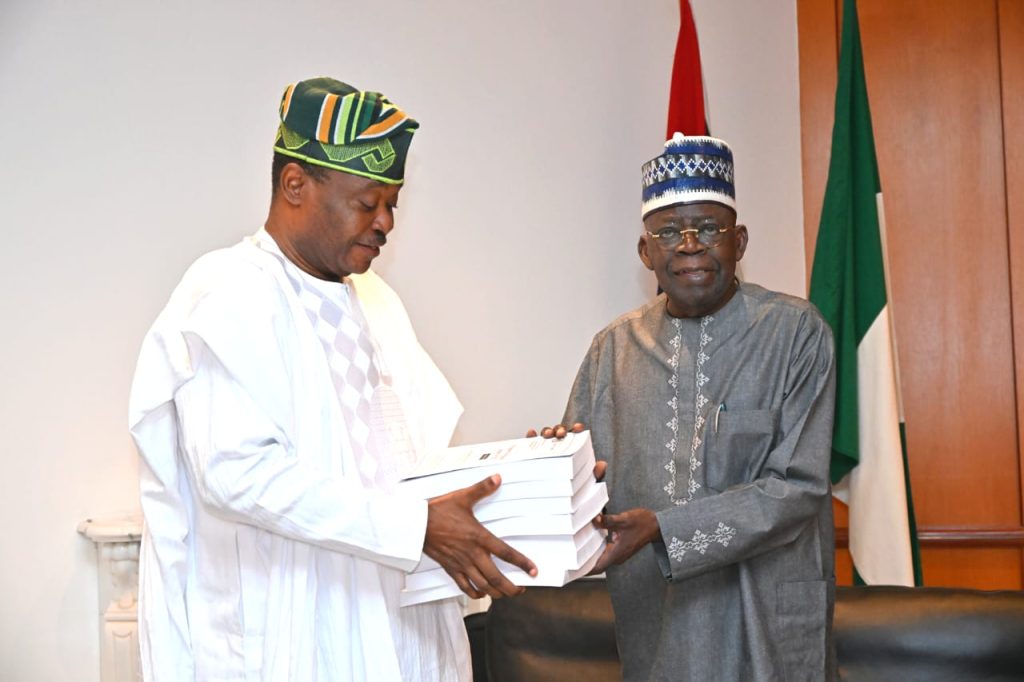
President Bola Tinubu has received the United Nations’ proposed 2027 budget from Nigeria’s Permanent Representative to the organisation, Jimoh Ibrahim.
Ibrahim, who chairs the UN General Assembly’s Fifth Committee on Administrative and Budgetary Matters, presented the seven-volume document to the President after the UN Secretary-General submitted it to the committee.
He described Nigeria’s chairmanship of the committee as a historic achievement, noting that the country had assumed the role for the first time in 66 years.
“This is the first time in 66 years that Nigeria will chair the Budget and Administrative Committee. It is the first time, and we do not know when it will happen again in history,” Ibrahim said.
He described Tinubu’s receipt of the proposed budget as a significant milestone for Nigeria, adding that the presentation marked an important moment in the country’s engagement with the UN’s administrative and financial affairs.
Ibrahim said the proposed UN regular budget was approximately $3.4 billion, with another $8.5 billion earmarked for peacekeeping operations. He put the overall financial provision at $14 billion, equivalent to between ₦36 trillion and ₦40 trillion.
“It is not a small matter for a country to receive the entire UN budget,” he said, expressing satisfaction that the President had received the document.
However, Ibrahim clarified that the budget was still at the proposal stage and would be subjected to detailed negotiations among member states before final approval and implementation.
“This is a proposed budget. It is the proposal submitted to member countries. Thereafter, the budget is discussed in detail, the figures are adjusted, and the final budget is approved before spending commences,” he explained.
On Nigeria’s potential allocation, the envoy declined to provide specific details, saying discussions with other committee members were still ongoing.
“As for Nigeria, I do not want to discuss what Nigeria will get from the budget. That would be going too far, because my colleagues and I are still discussing it,” he said.
Ibrahim also drew attention to the UN’s investments in Africa, citing the construction of a $260 million conference centre in Kenya as an example of the organisation’s development initiatives and their potential economic impact.
“A lot is happening. As of today, the United Nations is building a $260 million conference centre in Kenya. You can see what that means,” he said.
