
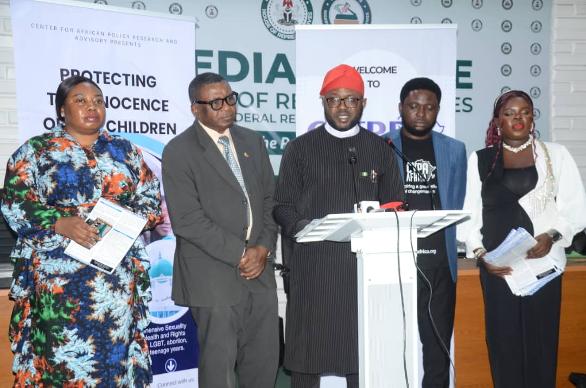
The Centre for African Policy Research and Advice (CAfPRA) has called on the National Assembly to urgently review Nigeria’s policies on sexuality education and reproductive health, particularly those affecting children.
The organisation made the call during a media engagement in Abuja, where it also urged lawmakers to scrutinise sexuality education programmes and materials used in schools.
CAfPRA expressed concern that some sexuality-related programmes and educational materials could expose young Nigerians to content it considers inappropriate for their age.
The organisation called on the National Assembly to examine relevant bills, policy documents and teaching materials, particularly those relating to children and sexuality education.
It also raised concerns about what it described as the growing influence of foreign interests on policy development in Nigeria, especially on issues relating to children and gender.
The Executive Director of CAfPRA, Segun Adebayo, said policies affecting Nigerian children should reflect the country’s social and cultural realities and should not be adopted without adequate consultation with parents, educators, civil society organisations and other stakeholders.
“We are dedicated to the policies of the land, to be sure that the policies of the government in Africa are consistent with the realities of Africa,” Adebayo said.
He alleged that some international organisations and foreign interests were attempting to influence public opinion in African countries as part of efforts to promote policy frameworks on sexuality, gender and reproductive health.
CAfPRA disclosed that it had written to the Presidency and the leadership of the National Assembly to communicate its concerns. It also said it planned to engage relevant legislative committees and circulate its policy recommendations to lawmakers.
Adebayo cited the case of a Junior Secondary School student who, according to him, produced an explicit drawing after allegedly encountering such material in a textbook.
“In Nigeria, if you look at the front, there’s a story there of a JSS student. This happened. I met the parents. The girl drew a very explicit diagram. Then the school saw it and asked her, where did you get this from? And she responded that it was from her textbook,” he said.
He said the incident raised questions about the nature of materials being introduced to children and the level of oversight provided by parents, schools and policymakers.
CAfPRA said it had commenced engagements with lawmakers and relevant National Assembly committees, including those responsible for basic education, and would share its policy recommendations with members.
The organisation urged policymakers to examine sexuality education programmes and materials to determine whether additional safeguards were needed to protect children.
Also speaking, the Head of Inner-City Mission for Children, Jane Chukwu, said children who had experienced sexual abuse required rehabilitation, education and skills development.
“We have rehabilitated children who were sexually abused far too early. So we get them in and disabuse their minds, train them and reform them before the information gets to them.’’
A CAfPRA member and human rights lawyer, Mr Sonnie Ekwowusi, called for a review of the school curriculum, alleging that some educational materials had not undergone adequate scrutiny.
“For a very long time now, we’ve not reviewed our curriculum for learning. And so some of these things are hidden in these things that people hardly see until you go in there. So it is time now to review those things,” Ekwowusi said.
He also said efforts were being made to influence public opinion, arguing that such changes could determine whether certain proposals eventually gained legislative support.
Also speaking, policy researcher and media personality Gold Boms said CAfPRA was examining legislative proposals and policies to determine whether they were consistent with Nigeria’s social realities.
Chris Yama, a representative of CYFPRA, described the policy review as an important discussion because of its potential implications for children and families.
“It is a very important conversation. It is on a topic that affects your children and your grandchildren. It is comprehensive sexuality education,” Yama said.
The group, however, argued that the current debate goes beyond conventional health education and requires closer examination of concepts associated with comprehensive sexuality education and sexual and reproductive health and rights.
