
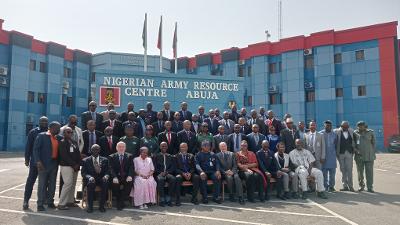
The Director-General, Nigerian Army Resource Centre, retired Major General James Myam, stated that while leadership within the Armed Forces remains sound, it must be continuously refined to stay relevant in a dynamic world shaped by shifting alliances, unconventional threats and fluid geopolitical competition.
He Stated this at the Senior Executive Leadership Programme held at the Nigerian Army Resource Centre, Abuja, organised in collaboration with King’s College London’s African Leadership Centre.
The programme aims to expose senior military officers and key stakeholders to contemporary geostrategic issues and strengthen analytical leadership capacity.
Major General Myam emphasised that the initiative is not a response to any deficiency in leadership but a deliberate effort to adapt to global developments, noting that modern leadership requires continuous learning and recalibration to remain effective in an increasingly complex security environment.
He explained that the programme is designed to sharpen participants’ analytical capabilities and align their strategic thinking with emerging global trends, ensuring that decisions are informed by knowledge-driven perspectives and a deeper understanding of evolving threats.
Also speaking, Professor Randolph Kent of King’s College London highlighted the growing complexity of global vulnerabilities, noting that insecurity is increasingly driven by interconnected factors such as fear, deprivation and systemic imbalance, which require adaptive and non-conventional approaches to address.
He observed that Nigeria is assuming a more central role in global security dynamics, with implications that extend beyond the continent, making its leadership decisions increasingly significant in shaping broader international stability.
Kent further stressed that contemporary challenges demand flexible and adaptive leadership models capable of interpreting underlying drivers of conflict and responding proactively, rather than relying on traditional frameworks.
The programme also provided a platform for mutual exchange of knowledge, combining international academic perspectives with Nigeria’s operational experience, aimed at developing leaders capable of navigating both local and global security environments.
The collaboration underscores Nigeria’s broader strategic intent to position its leadership within a global context.
