
Poland shot down suspected Russian drones in its airspace on Wednesday with the support of NATO aircraft, marking the first known instance of a member of the Western military alliance firing shots during Russia’s war in Ukraine.
Prime Minister Donald Tusk told parliament the incident was “the closest we have been to open conflict since World War Two,” though he added there was “no reason to believe we’re on the brink of war.”
Officials said Polish F-16 fighter jets, Dutch F-35s, Italian AWACS surveillance planes, and NATO mid-air refuelling aircraft scrambled in an overnight operation to intercept drones entering Polish airspace from Tuesday evening until Wednesday morning.
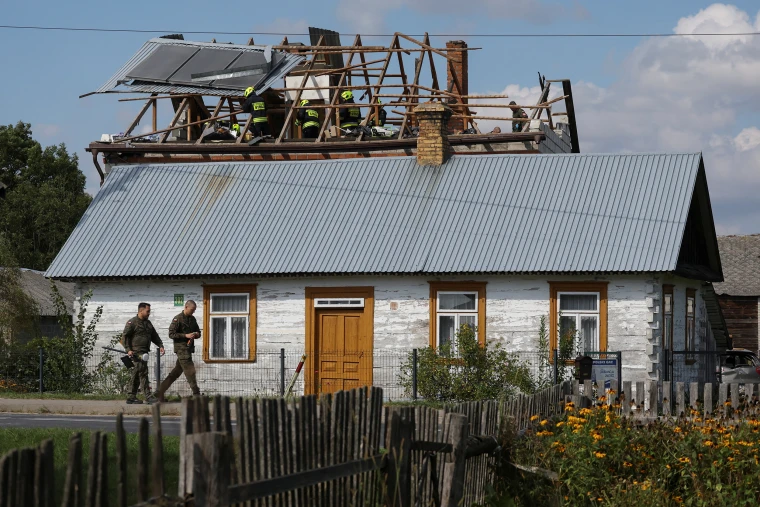
One drone struck the two-storey brick house of pensioner Tomasz Wesolowski in the eastern village of Wyryki-Wola at about 6:30 a.m. while he was downstairs watching news reports about the incursion.
“The house needs to be demolished,” Wesolowski told Reuters, describing how the roof was destroyed and debris scattered across a bedroom. Burned patches of farmland elsewhere in southeastern Poland also indicated where other drones had crashed.
Moscow Denies Responsibility
Russia’s Defence Ministry confirmed it had launched a major attack on military facilities in western Ukraine but insisted it had not targeted Poland. Andrey Ordash, Russia’s charge d’affaires in Warsaw, dismissed accusations of Russian involvement as “groundless.”
U.S. President Donald Trump spoke with Polish President Karol Nawrocki, describing the call as part of ongoing consultations with allies. “Today’s talks reaffirmed our unity,” Nawrocki wrote on X. Earlier, Trump posted: “What’s with Russia violating Poland’s airspace with drones? Here we go!” without elaborating further.
Leaders of France, Britain, Germany, and Canada condemned the suspected Russian incursion, while Slovenia, Denmark, Greece, France, and Britain requested a United Nations Security Council meeting on Friday.
Poland reported that 19 objects had entered its airspace during Russia’s overnight assault on Ukraine, and that it had shot down those posing a threat. Tusk labelled the incident a “large-scale provocation” and confirmed he had triggered Article 4 of NATO’s founding treaty, which allows members to call consultations when their security is threatened.
A senior Polish military source said at least five drones appeared to be headed towards Rzeszow airport, NATO’s main logistics hub for military supplies to Ukraine. The source suggested Russia may have been testing NATO’s air defences and warning systems.
NATO Secretary-General Mark Rutte called the incursion “absolutely reckless,” while Ukrainian President Volodymyr Zelenskiy said it highlighted the urgency of building a joint European air defence system.
The Polish army said at least some of the drones were Gerbera models long-range systems that Ukrainian intelligence claims are assembled in Russia using Chinese-manufactured kits.
During the operation, the Polish Armed Forces urged residents in three eastern regions to remain indoors. Several airports, including Rzeszow, were temporarily closed. The Czech Defence Ministry announced it would send three Mi-171S helicopters to Poland to strengthen its low-altitude drone defence.
Countries bordering Ukraine have previously reported stray Russian missiles or drones entering their airspace, but never on this scale. The last fatal incident occurred in 2022, when a Ukrainian air defence missile accidentally struck Poland, killing two people.
Since NATO’s founding in 1949, Article 4 has been invoked seven times, most recently in February 2022 after Russia’s invasion of Ukraine.
“This is going to shock the NATO alliance and neighbouring states they are all in the same situation,” said Riki Ellison, a U.S.-based missile defence expert. “It’s not the beginning of World War Three, but it’s shaping Russia’s understanding of how we fight and where our weaknesses lie.”
European Commission President Ursula von der Leyen urged tougher sanctions on Moscow, including restrictions on its “shadow fleet” of oil tankers and on third countries that continue to purchase Russian crude.
