
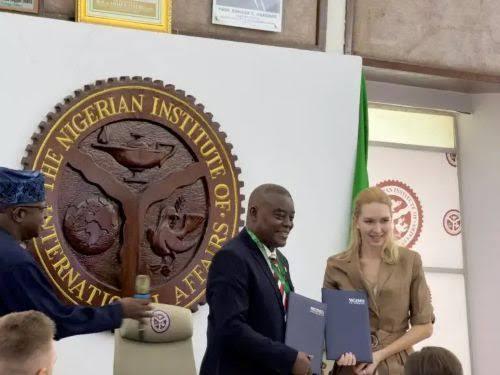
The Nigerian Institute of International Affairs (NIIA) and Moscow State Institute of International Relations (MGIMO) have signed a Memorandum of Understanding (MoU) to strengthen institutional collaboration, academic exchange, and joint research initiatives.
The agreement followed a roundtable themed: “Nigeria and Russia in the Changing and Challenging World Order.” MGIMO, a leading Russian university and think tank under the Ministry of Foreign Affairs, will work with NIIA to expand scholarships, training, and research opportunities for Nigerian professionals.
Alexey Starikov, Attaché at the Russian Embassy in Nigeria, highlighted longstanding goodwill between the two countries and stressed the need to translate it into concrete projects. He identified priority areas for cooperation, including energy, agriculture, education, and security, while emphasising the importance of multilateral engagement and sovereign equality in a shifting global order.
Starikov also revealed preparations for the Russia–Nigeria Intergovernmental Commission on Economic, Scientific and Technical Cooperation, scheduled for May in Kazan, Russia. He said the platform is expected to produce practical outcomes in infrastructure, agriculture, and technology.
Maya Nikolskaya, Head of Africa Programme at MGIMO, described the current global system as fragmented and stressed that Nigeria and Russia could adopt “antifragility” to navigate uncertainties. She highlighted the growing importance of human capital, technology, and data, as well as educational partnerships to build capacity in Africa.
From the Nigerian side, Prof. Joshua Bolarinwa, NIIA’s Director of Research, noted that Russia’s engagement in West Africa reflects a broader geopolitical strategy to challenge Western dominance and expand influence. Dr Adesuwa Erediauwa, Head of NIIA’s Bashir Adeniyi Centre for International Trade and Investment, urged efforts to diversify Nigeria’s exports to Russia, citing a current trade imbalance of $676 million in imports versus $1.5 million in exports.
The MoU is seen as a step toward deeper, more balanced economic and academic cooperation between Nigeria and Russia, leveraging mutual interests in a multipolar world order.
