
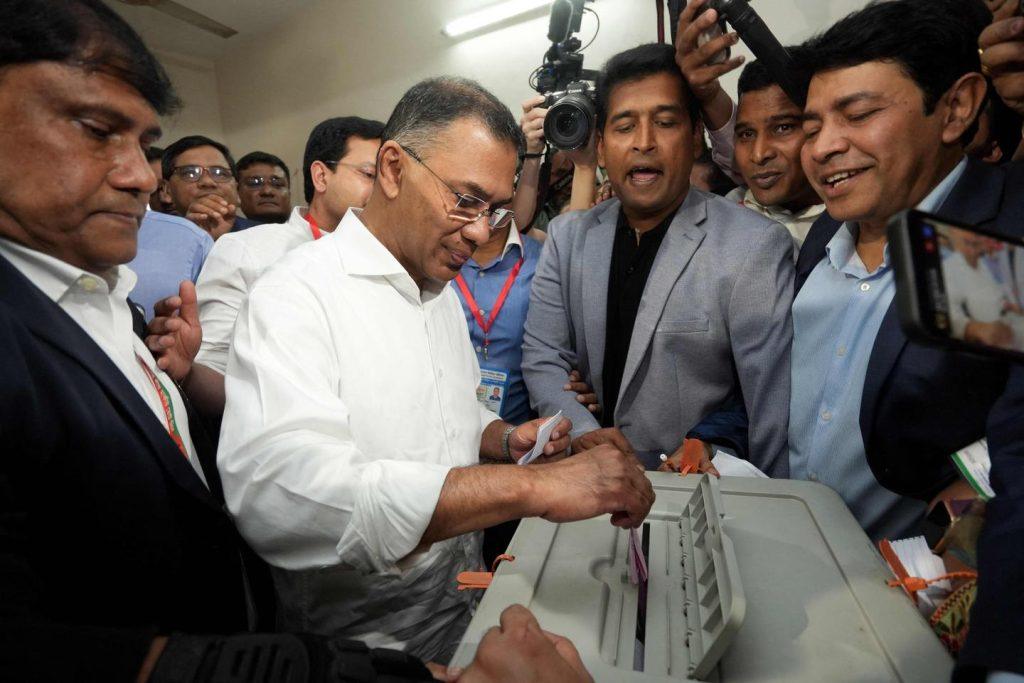
The Bangladesh Nationalist Party (BNP) has secured victory in Friday’s parliamentary election, returning to power after nearly two decades in opposition.
The result paves the way for party leader Tarique Rahman to assume office as prime minister at a time when the country is emerging from months of political unrest and economic disruption.
According to provisional results reported by local television stations, the BNP and its allies won at least 212 of the 299 contested seats. The Election Commission placed the BNP at 181 seats, Jamaat-e-Islami at 61, and other parties at seven, with final official results expected within hours.
Although counting in several constituencies was still under way, the Commission indicated that the formal gazette notification of results may take several days. Under the constitution, the new government cannot be sworn in until the gazette is published.
Rahman, the son of former Prime Minister Khaleda Zia, returned to Dhaka in December after nearly 20 years abroad. He faces immediate challenges, including restoring political stability, rebuilding investor confidence and revitalising key industries such as garment manufacturing, which suffered during the prolonged crisis that followed the collapse of Sheikh Hasina’s government last year.
The opposition Jamaat-e-Islami and its allies secured 70 seats in the Jatiya Sangsad, or House of the Nation. Despite achieving its highest-ever parliamentary tally, the party said it was “not satisfied” with the electoral process and urged supporters to remain patient.
In a statement issued after trends confirmed its lead, the BNP thanked supporters and called for special prayers for the nation. “Despite winning … by a large margin of votes, no celebratory procession or rally shall be organised,” the party said.
The National Citizen Party (NCP), led by youth activists involved in the protests that unseated Hasina, won only five of the 30 seats it contested.
A decisive outcome was widely regarded as essential for restoring stability in the Muslim-majority nation of 175 million people. Bangladesh is the world’s second-largest exporter of garments, and the sector has been severely affected by the recent unrest.
“A strong majority gives the BNP the parliamentary strength to pass reforms efficiently and avoid legislative paralysis. That alone can create short-term political stability,” said Selim Raihan, an economics professor at the University of Dhaka.
In its manifesto, the BNP pledged to prioritise job creation, protect low-income households and ensure fair prices for farmers.
“If the factories run regularly and we get our wages on time, that’s what matters to us. I just want the BNP government to bring back stability so more orders come to Bangladesh and we can survive,” said Josna Begum, a 28-year-old garment worker and mother of two.
International leaders, including India’s Prime Minister Narendra Modi, Pakistan’s Prime Minister Shehbaz Sharif and the United States ambassador to Bangladesh, Brent T. Christensen, were among the first to congratulate Rahman.
Turnout reportedly approached 60 per cent, higher than the 42 per cent recorded in the 2024 election. More than 2,000 candidates contested the vote, representing at least 50 political parties. Voting in one constituency was postponed following the death of a candidate.
Alongside the election, a referendum on constitutional reforms was also held. Proposed changes include a two-term limit for prime ministers, strengthened judicial independence, greater representation for women, the establishment of neutral interim governments during election periods, and the creation of a second parliamentary chamber.
