
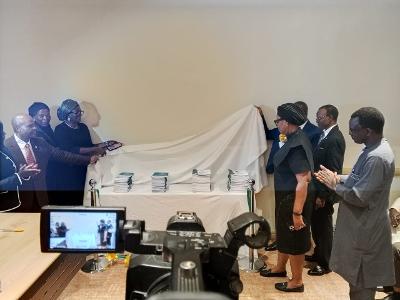
The Federal Ministry of Justice has unveiled the National Minimum Standards (2025) and the Harmonised Restorative Justice Training Curriculum and Manual (2025), in a move aimed at strengthening Nigeria’s criminal justice system and aligning it with global best practices.
The initiative is designed to improve efficiency, fairness and accountability within the justice sector, while promoting restorative justice as a complementary approach to conventional court processes.
The Attorney General of the Federation and Minister of Justice, Lateef Fagbemi, said the Administration of Criminal Justice Act (ACJA) has continued to enhance justice delivery in the country through reforms such as improved conviction processes, plea bargaining, prohibition of arrest by proxy and strengthened asset recovery.
“Over the past decade, Nigeria has undertaken several reforms aimed at improving the efficiency, fairness and accountability of our criminal justice system,” he said.
He added that, “One of the key pillars of these reforms has been the implementation of the provisions of the Administration of Criminal Justice Act (ACJA) 2015, which introduced innovative mechanisms to ensure speedy justice delivery and the decongestion of correctional centres.”
Speaking at a sensitisation workshop and unveiling ceremony in Abuja, the Director of the Administration of Criminal Justice Reform Department, Mrs Leticia Ayoola-Daniels, described the development as a milestone in Nigeria’s justice reform efforts.
“It is with great honour and a deep sense of responsibility that I welcome you all to this landmark occasion heralding the unveiling of the National Minimum Standards (2025), the Harmonised Restorative Justice Training Curriculum and Manual (2025), alongside this sensitisation workshop,” she said.
She explained that the reforms reflect years of collaboration and policy development aimed at embedding restorative justice within the country’s legal framework.
She noted that the Ministry has already recorded progress in implementing restorative justice in the Federal Capital Territory since 2022, in collaboration with relevant justice institutions and stakeholders.
“In 2023, the Ministry coordinated engagements with an ad hoc committee, facilitators and justice institutions, including a study visit to Lagos State, which informed the development of key policy documents such as the Restorative Justice Policy, Bill, Practice Direction and Training Manual,” she added.
According to her, the newly introduced National Minimum Standards will guide the implementation of restorative justice programmes nationwide, ensuring consistency while adapting to local conditions.
She further explained that the training curriculum and manual will help standardise the capacity-building process for facilitators and ensure uniform application of restorative justice principles across jurisdictions.
Also speaking, the Chief Judge of the Federal High Court, Justice John Tsoho, represented by Justice James Omotosho, described the Administration of Criminal Justice Act 2015 as a landmark reform that has improved efficiency and fairness in Nigeria’s justice system.
He said the reforms represent a shift towards a more responsive and modern justice administration framework.
The Ministry said the initiative is expected to enhance accountability, strengthen alternative dispute resolution mechanisms and align Nigeria’s justice system with global standards.
